
About ECSA
Our year at a glance
Following is a snapshot of data and statistics from the 2019-20 financial year.
Download a copy of the Annual Report 2019-20.
Our highlights
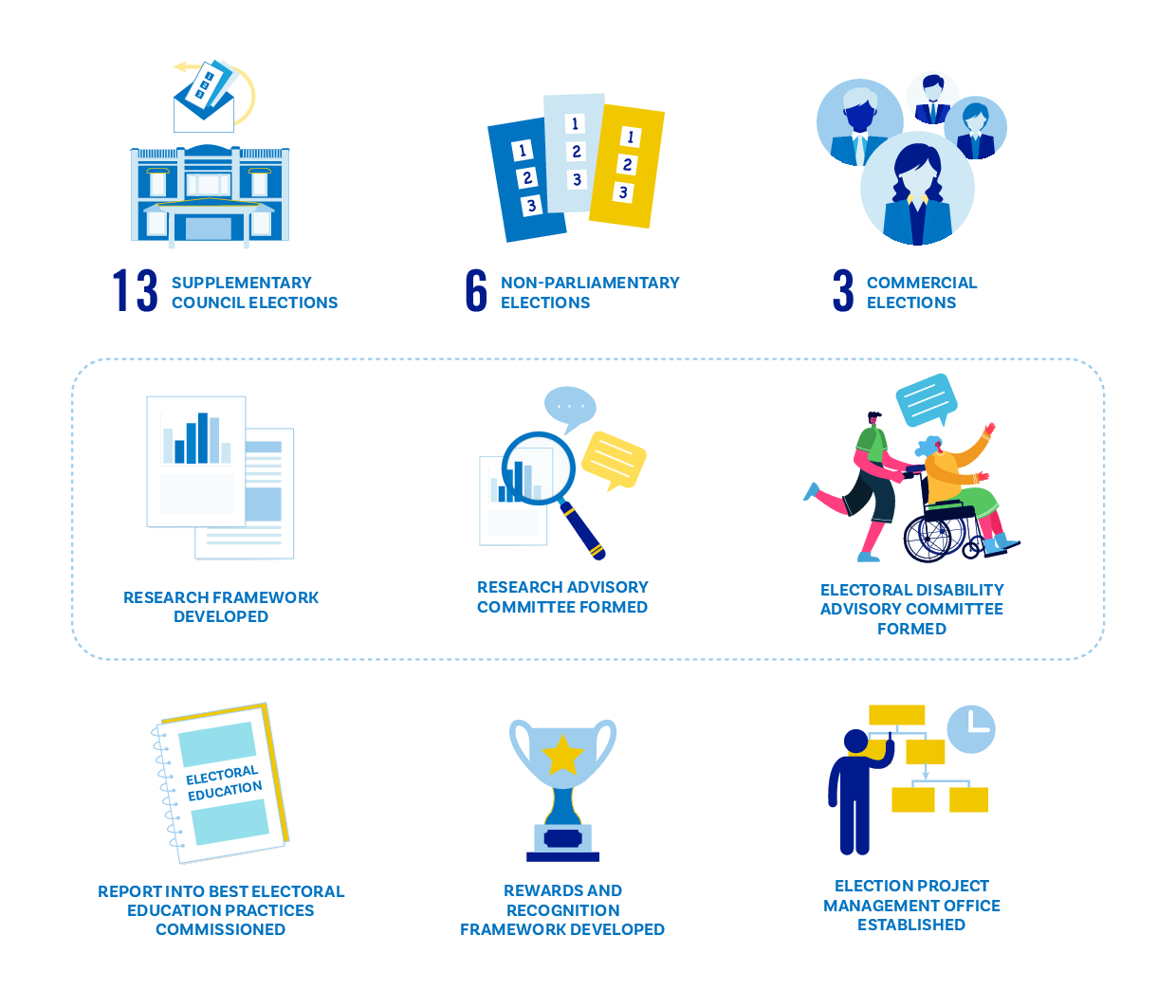
Our people
| Number of staff | 30 | |
| FTEs | 27.83 | |
| Gender | Persons | FTE |
| Female | 53% | 51.5% |
| Male | 47% | 48.5% |
| No. persons separated from the agency during 2019-20 | 4 | |
| No. persons recruited to the agency during 2019-20 | 2 | |
| No. persons on leave without pay at 30/6/20 | 7 | |
Elections
Summary of council elections
| Council | Date | Ratio of candidates to vacancy | No of electors on roll | Election contested | Participation (no) | Participation (%) |
| Mid Murray Council Shearer Ward |
8/7/19 | 4:1 | 3,127 | Y | 1,118 | 35.75% |
| Wattle Range Council Corcoran Ward |
9/9/19 | 4:1 | 4,113 | Y | 1,677 | 40.77% |
| District Council of Lower Eyre Peninsula Area Councillor |
8/10/19 | 3:1 | 3,830 | Y | 1,192 | 31.12% |
| District Council of Robe Area Councillor | 11/11/19 | 3:1 | 1,276 | Y | 619 | 48.51% |
| District Council of Ceduna Area Councillor | 9/12/19 | 2:1 | 2,114 | Y | 962 | 45.51% |
| District Council of Grant Central Ward | 9/12/19 | 3:1 | 4,405 | Y | 1,189 | 26.99% |
| City of Marion Woodlands Ward | 9/12/19 | 7:1 | 11,048 | Y | 1,792 | 16.22% |
| District Council of Mount Remarkable Willochra Ward | 9/12/19 | 2:1 | 1,201 | Y | 503 | 41.88% |
| District Council of Franklin Harbour Area Councillor | 24/2/20 | 2:1 | 891 | Y | 533 | 59.82% |
| City of Port Adelaide Enfield Enfield Ward | 24/2/20 | 8:1 | 15,164 | Y | 4,417 | 29.13% |
| District Council of Yankalilla Light Ward | 24/2/20 | 3:1 | 2,320 | Y | 973 | 41.94% |
| City of Adelaide Central Ward | 11/5/20 | 8:1 | 11,689 | Y | 2,193 | 18.76% |
Council vacancies
Councils carrying a vacancy during this period were:
- Kangaroo Island Council
- Port Pirie Regional Council
- District Council of Orroroo Carrieton.
These councils adopted a policy not to fill a casual vacancy until the next general election, however if a subsequent vacancy occurs prior to January 2022, a supplementary election must be held to fill all the vacancies.
Council polls
The District Council of Coober Pedy held four concurrent polls. The mailout occurred on 1 October 2019 with the scrutiny and count held on Tuesday 22 October 2019. The total number of enrolled electors was 985. Three hundred and fifty envelopes were returned, for a participation rate of 35.53%.
| Question | In favour (no.) | In favour (%) | Opposed (no.) | Opposed (%) | Informal (no.) | Informal (%) | Total ballot papers |
| Question 1: Do you support the Council conducting a poll of electors on every occasion when it proposes to increase municipal rates by more than CPI? | 255 | 74.78% | 86 | 25.22% | 0 | 0.00% | 341 |
| Question 2: Do you support the Council selling its electricity assets and business to the State Government should it be financially sensible to do so? | 175 | 51.17% | 167 | 48.83% | 0 | 0.00% | 342 |
| Question 3: Do you support the Council selling its water assets and business to the State Government should it be financially sensible to do so? | 183 | 53.35% | 160 | 46.65% | 0 | 0.00% | 343 |
| Question 4: Do you support the term of administration of the Council being continued until the next scheduled general election for the Council in November 2022? | 240 | 70.38% | 100 | 29.33% | 1 | 0.29% | 341 |
Anangu Pitjantjatjara Yankunytjatjara Lands Executive Board elections
ECSA conducted 3 supplementary elections for the Anangu Pitjantjatjara Yankunytjatjara (APY) Executive Board in November and December 2019.
These elections were held to fill 3 vacancies, 1 within each of the following communities:
- Mimili – 1 female member
- Amata and Tjurma – 1 male member
- Pukatja, Yunyarinyi, Anilalya and Turkey Bore – 1 male member
| Electorate | Date of election | Number of electors | Election contested? | Participation (no.) | Participation (%) | Electoral system used |
| Mimili | 13/11/19 | 194 | No – Ms Julieanne Campbell elected unopposed | - | - | Single-member first past the post voting |
| Amata and Tjurma | 13/11/19 | 258 | No – no eligible nominations received | - | - | Single-member first past the post voting |
| Pukatja, Yunyarinyi, Anilalya and Turkey Bore | 4/12/19 | 374 | Yes – Mr Gary Lewis elected | 81 | 21.66% | Single-member first past the post voting |
Other statutory elections
| Organisation | Date | Election type | Election contested? | No. elected | Electoral system used | No. of electors |
| The Architectural Practice Board of South Australia | 18/3/20 | Election of Board members | Y | 3 | Proportional representation | 912 |
| South Eastern Water Conservation and Drainage Board – Northern Zone | 22/6/20 | To elect 1 Landholder to the Board | N | 1 | Single-member plurality voting | 831 |
| South Eastern Water Conservation and Drainage Board – Central Zone | 22/6/20 | To elect 1 Landholder to the Board | N | 1 | Single-member plurality voting | 1066 |
The elections for the South Eastern Water Conservation and Drainage Board are held every four years. In total, three elections are managed for the following electoral zones; Central Electoral Zone, Northern Electoral Zone and Southern Electoral Zone. At the close of nominations on Monday 22 June 2020, only 1 nomination was received for the Central Electoral Zone, with Brett McLaren elected unopposed, and the Northern Electoral Zone, with Miles Weston Hannemann elected unopposed.
Two nominations were received for the Southern Electoral Zone. Ballot packs were sent out to those eligible electors with the election being finalised in the 2020 – 21 financial year.
Community and commercial elections
| Organisation | Date | Election type | No. elected | Voting method | No. of electors |
| Department of Treasury and Finance | 26/7/19 | Enterprise Agreement ballot | - | FPTP* | 193 |
| Department of Treasury and Finance | 11/10/19 | Enterprise Agreement ballot | - | FPTP | 192 |
| Civil Contractors Federation SA Board Election | 26/9/19 | Election of Board members | 7 | FPTP | 145 |
*First past the post
Enrolment
South Australia enrolment rate at 30 June 2020
| Enrolment | 30 June 2020 | 30 June 2019 | 30 June 2018 | 30 June 2017 | 30 June 2016 |
| Enrolment for federal/state and state only electors | 1,224,894 | 1,216,151 | 1,201,245 | 1,187,714 | 1,185,994 |
| Voting Eligible Population* | 1,263,503 | 1,248,996 | 1,241,490 | 1,241,031 | 1,234,717 |
| Total enrolled as % of Voting Eligible Population* | 96.9% | 97.4% | 96.8% | 95.7% | 96.1% |
Electors enrolled by age group at 30 June 2020
| Age group | No. | % of Voting Eligible Population* |
| 18-24 | 109,517 | 81.5% |
| 25-34 | 187,109 | 97.4% |
| 35-44 | 190,314 | 98.8% |
| 45-54 | 204,532 | 98.2% |
| 55-64 | 209,952 | 98.2% |
| 65+ | 323,470 | #99.0% |
| Total enrolled | 1,224,894 | 96.9% |
*Voting Eligible Population percentages are calculated by the Australian Electoral Commission (AEC) based on Estimated Eligible Population using ABS citizen population figures for 30 June 2017 (final) and 30 June 2019 (preliminary) based on the 2016 Census. ABS data is adjusted by the AEC and projected forward to the relevant date, then adjusted for British Subjects, those of unsound mind, overseas electors and new citizens since the Census.
# Enrolment rates above 99.0% are not reported due to error associated with calculating Estimated Eligible Population which may overstate the actual enrolment rate.
Enrolment transactions 2017 to 2020
| Enrolment activity | 2019-20 | 2018-19 | 2017-18 | 2016-17 |
| As at 1 July of each year | 1,216,151 | 1,201,245 | 1,187,714 | 1,185,994 |
| Additions to the roll | 2019-20 | 2018-19 | 2017-18 | 2016-17 |
| New enrolments* | 23,496 | 27,477 | 27,610 | 22,417 |
| Re-enrolments | 4,351 | 5,109 | 5,238 | 4,549 |
| Re-instatements | 25 | 143 | 67 | 1,035 |
| Interstate transfers to SA | 11,112 | 15,267 | 14,235 | 10,236 |
| Net additions | 38,984 | 47,996 | 47,150 | 38,237 |
| Movements within state** | 2019-20 | 2018-19 | 2017-18 | 2016-17 |
| Transfers between districts | 74,255 | 80,728 | 86,541 | 74,421 |
| Changes within district | 34,209 | 42,648 | 49,974 | 39,876 |
| No change/amendments | 7,491 | 20,235 | 40,535 | 8,915 |
| Deletions from the roll | 2019-20 | 2018-19 | 2017-18 | 2016-17 |
| Removal by objection | 6,665 | 5,737 | 3,602 | 12,327 |
| Deaths | 10,932 | 10,793 | 11,735 | 11,049 |
| Duplications | 701 | 309 | 496 | 852 |
| Cancellations | 169 | 170 | 16 | 89 |
| Interstate transfers from SA | 11,776 | 16,084 | 17,777 | 12,208 |
| Net deletions | 30,243 | 3,093 | 33,626 | 36,525 |
| Adjustments (net)*** | +2 | +3 | +7 | +8 |
| Total enrolled 30/06/20 | 1,224,894 | 1,216,151 | 1,201,245 | 1,187,714 |
* Includes persons who have provisionally enrolled that have turned 18 and new enrolments by 18 year olds (8,226 in 2019-20).
** These ‘movements within state’ figures are not included in the table totals below.
*** Net adjustments and data corrections.
Registered declaration voters by criteria at 30/6/20
ECSA maintains a register of voters who are permanently prevented from attending a polling booth and meet certain criteria. These voters are called registered declaration voters for state elections and general postal voters for federal elections. Once registered, a voter will always receive a postal vote for every election and does not need to re-apply for future elections.
| Criteria | No. | % |
| Caring for a person who is seriously ill, infirm or disabled | 1,392 | 5.9% |
| Place of residence is not within 20 kilometres of a polling place | 3,515 | 14.9% |
| Physical disability | 7,117 | 30.1% |
| Membership of a religious order or religious beliefs | 454 | 1.9% |
| Address has been suppressed from publication on the roll (silent elector) | 11,145 | 47.2% |
| Total | 23,623 | 100% |
Register of political parties
Eight political parties were registered for state elections in South Australia.
| New party registrations | 0 |
| Annual returns lodged | 8 |
| De-registrations* | 4 |
| Currently registered parties (as at 30 June 2020) | 8 |
*The following parties were de-registered on 28/11/2019 for failure to have the required number of members to continue as an eligible political party under section 45 of the Electoral Act 1985: Danig Party of Australia (SA Division), Dignity Party Inc, Liberal Democratic Party, Stop Population Growth Now Party.
Registered political parties at 30 June 2020
| Date of registration | Name of registered political party | Abbreviation of party name |
| 17/10/85 | Australian Labor Party (South Australian Branch) | Australian Labor Party |
| 17/10/85 | Liberal Party of Australia (SA Division) | Liberal Party |
| 17/10/85 | National Party of Australia (SA) Inc | The Nationals |
| 13/2/96 | Australian Greens SA | The Greens |
| 24/11/16 | Animal Justice Party | |
| 4/7/17 | SA-BEST Incorporated | SA-BEST |
| 7/11/17 | Advance SA | |
| 12/12/17 | Child Protection Party | CPP |
Funding, disclosure and returns
Returns
Political Party Returns, Associated Entity Returns and Donor Returns are lodged on a half-yearly basis and must be lodged within 30 days of the end of the half-yearly period.
In January 2020, ECSA received returns for the period 1 July 2019 to 31 December 2019. The table below summarises the return lodgements for the period.
Returns for period 1 July 2019 to 31 December 2019.
| Return type | Total lodged | Late returns |
| Political Party Return | 10* | 2 |
| Associated Entity Return | 21 | 6 |
| Donor Return | 5 | 3 |
*Danig Party of Australia (SA Division) and Liberal Democratic Party lodged a return, however were deregistered on 28 November 2019.
All returns lodged are available on ECSA’s Funding and Disclosure Portal.
Public funding
| Claim Period | Australian Labor Party | Liberal Party | The Greens | SA-Best | Advance SA | Total |
| 1/7/19 – 31/12/19 | $64,568 | $64,568 | $37,665 | $37,665 | $952.04 | $205,418 |
| 1/1/20 – 30/6/20 | $64,568 | $64,568 | $37,665 | $37,665 | - | $204,466 |
| Total | $129,136 | $129,136 | $75,330 | $75,330 | $952.04 | $409,884.04 |
No general election or by-election was held in the 2019-20 financial year and ECSA was not called upon to pay election funding to reimburse political expenditure incurred by eligible participants in relation to an election.
Non-voter activity
Non-voter activity
Section 85 of the Electoral Act 1985 sets out the procedures to be implemented by the Electoral Commissioner relating to electors who appear to have not voted at an election. The non-voter process commences three months after election day and continues until each expiation has been resolved.
The table below outlines the non-voter activity, starting with Notice 1 which gives the elector the opportunity to provide a valid reason for their apparent failure to vote, through to referral of the expiation to the Fines Enforcement and Recovery Unit (FERU).
Once an expiation has been referred to FERU an elector can make an application for a review. If the review is granted the expiation is referred back to ECSA and the expiation is reissued (Notice 2). There is no maximum numbers of review that can be granted. This cycle can occur multiple times if the matter is left unresolved.
| Activity | 2019-20 | 2018-19 | 2017-18 |
| Notice 1: Notice of Apparent Failure to Vote (No. sent) | n/a | * n/a # 8,747 |
* 63,715 |
| Notice 2: Expiation Notice (No. sent) | n/a | * 37,480 # 5,966 |
n/a |
| Notice 3: Reminder Expiation Notice (No. sent) | * n/a # 4,046 |
* 27,942 # n/a |
n/a |
| Referrals to the Fines Enforcement and Recovery Unit for enforcement | * 257 # 3,278 |
* 23,115 # n/a |
n/a |
| Re-issued expiation notices (No. sent) | * 1,605 # 413 |
* 3,873 # n/a |
n/a |
| Penalties collected ($) | $389,543.65 | $769,097.43 | $20,447.40 |
* 2018 State Election
# 2019 Cheltenham and Enfield by-elections
The new Public Interest Disclosure Act 2018 (PID Act) commenced on 1 July 2019, replacing the Whistleblowers Protection Act 1993.
The PID Act strengthens transparency and accountability in government by establishing a scheme that encourages and facilitates the appropriate disclosure of public interest information to certain persons or authorities. It provides protection for some people who make appropriate disclosure of public interest information in accordance with the PID Act and sets out processes for dealing with such disclosures.
What is public interest disclosure?
The PID Act establishes a process that encourages and facilitates the disclosure of public interest information to certain persons or authorities; this information is a public interest disclosure.
A public interest disclosure is a disclosure (report) that is made by a person who discloses to a relevant authority information that indicates wrongdoing in relation to 2 types of public interest information:
- Environmental and health information — is information that raises a potential issue of a substantial risk to the environment or to the health and safety of the public generally or a significant section of the public, whether occurring before or after the commencement of the PID Act.
- Public administration information — any information that raises a potential issue of corruption, misconduct or maladministration in public administration (whether occurring before or after the commencement of the PID Act).
Making a public interest disclosure
To make a public interest disclosure to Electoral Commission SA (ECSA) the responsible officer can be contacted by:
Email:
Telephone: 1300 655 232 and ask for the responsible officer.
Post:
Public interest disclosure
Electoral Commissioner SA
GPO Box 646 Adelaide SA 5001
Note: mark the envelope private and confidential.
Public interest disclosure procedure and resources
For further information on making a public interest disclosure to ECSA, please refer to the documents linked below:
- Public interest disclosure procedure (PDF, 469KB)
- Additional resource 1:
Making an appropriate disclosure of public interest information (PDF, 195KB) - Additional resource 2:
Receiving and dealing with an appropriate disclosure of public interest information (PDF, 170KB) - Additional resource 3:
How informants can contact ECSA (PDF, 49KB)
For further information visit the Independent Commission Against Corruption website.
Department of Premier and Cabinet established new guidelines for Annual Reporting with reforms stipulating only information required by Act, Regulation or public complaints by the Ombudsman to be included with audited Financial Statements.
In support of legislative annual reporting requirements, ECSA has developed this ‘Year in Review’ with highlights of 2016–17 together with other information reporting on performance.
Contents within Year in Review include:
- Highlights for Reporting Year 2016–17
- Elections
- Aṉangu Pitjantjatjara Yankunytjatjara (APY) Executive Board elections
- Other election services
- Supplementary elections and casual vacancies
- Local Government Representation Reviews
- Enforcement of compulsory voting
- Funding and Disclosure
- Online lodgement system
- Disclosures
- Special assistance funding
- Reciprocal arrangements with electoral commissions
- Interstate Elections 2016–17
- WA Secondments
- Community awareness and information
- Community engagement events
- Consultative stakeholder engagement meetings
- Promoting a healthy and safe work environment
- Wellness and engagement
- Risk management
- Work health and safety workshops and training
- WHS risks
Highlights for Reporting Year 2016–17
Appointment of new Electoral Commissioner
On 20 February 2017, Mick Sherry was appointed the South Australian Electoral Commissioner. Upon appointment, a key priority for the remainder of 2016-17 was to ensure ECSA was structured and operating effectively to deliver future key priorities including the State Election and Local Government Elections in 2018.
New Strategic Plan for ECSA
After a significant planning process, a new four-year strategic plan was implemented. The Strategic Plan 2017-20 focuses on our purpose of providing high quality electoral services for South Australians and is built around the following four strategic priorities:
- Delivering high quality elections services
- Engaging the community and stakeholders to promote awareness, participation and compliance in electoral matters.
- Conduct research into a range of electoral matters
- Cultivate a high performing values-based organisation.
To help shape the culture of the organisation, the new Strategic Plan also included the following new organisational values:
Independent: acting with impartiality and transparency
Professional: demonstrating respect, integrity and accountability at all times
Innovative: an agile, creative, engaged and responsive organisation
An organisational realignment was implemented to ensure ECSA was positioned to deliver the four strategic priorities of the strategic plan.
Strategies to improve internal communication and a new governance framework including the introduction of an Organisational Health Committee to monitor ECSA’s corporate responsibilities were
implemented.
Electoral Districts Boundaries Commission
ECSA provided considerable support during 2016-17 to the Electoral Districts Boundaries Commission (EDBC) with the development and support of a dedicated website to deliver all information relating to the deliberations of the EDBC. Additional administrative assistance assisted in the development of a separate records management system for the EDBC, relating to current and past EDBC records.
Voting data from the 2014 State Election was extracted and used to undertake a geographic analysis of boundary changes and political consequences. Budgeting and finance services were also provided along with procuring printing services for both the EDBC’s Draft and Final Reports.
Following the unsuccessful Full Court challenge against the Order of the EDBC, considerable effort was put into identifying and encoding the necessary boundary changes into the national Roll Management System (RMANS) to enable rolls to be prepared for the next election.
Working together with other electoral commissions
The Electoral Council of Australia and New Zealand (ECANZ) is the peak body comprising Electoral Commissioners from the Commonwealth of Australia, New Zealand and each of the States and Territories. ECANZ has promoted the establishment of national working groups to focus on various operational and administrative areas of election administration.
Staff from the ECSA are currently serving as members on working groups including, Materials Management, Internet Voting and Indigenous Participation. An additional workshop was convened during the year to enable officers responsible for administration of Funding and Disclosure legislation to meet and share experiences in this new and complex area of electoral law.
Several ECANZ meetings were held during the year with the schedule programming a joint meeting and workshop hosted by ECSA in November 2016. Following the ECANZ meeting, a full day facilitated workshop was held on stakeholder management with Prof Dean Jaensch AO and the Hon John Hill MP, former Minister for Health and the ALP State Secretary participating in a round-table discussion on stakeholder expectations. The major session of the day, attended by Electoral Commissioners and senior elections administrators, provided a hypothetical crisis management situation with the group tasked with identifying processes, procedures and stakeholder management challenges where a polling official was the subject of a one-punch attack with the polling place becoming a crime scene. A report on the outcome of the workshop was prepared and presented to ECANZ at a later meeting.
Forward focus
Over the next 12 months, the focus of the organisation will be on preparing and delivering the State Election in March 2018. Significant changes will be involved for the next election including:
- a new voting method for the Legislative Council;
- additional voting options for sight impaired electors;
- a new funding and disclosure portal; and
- the introduction of an EasyVote Card App that will provide important information to electors.
Elections
Aṉangu Pitjantjatjara Yankunytjatjara (APY) Executive Board elections
Elections for the Aṉangu Pitjantjatjara Yankunytjatjara (APY) Executive Board are held every three years. The board has 14 members, with two members elected from each electorate. Each electorate will be represented by one female and one male board member.
Management of elections for the APY Executive Board present significant challenges due to the remoteness of each of the communities within the APY Lands, located some 1200–1400 kilometers from Adelaide, particularly with a seven-day nomination period.
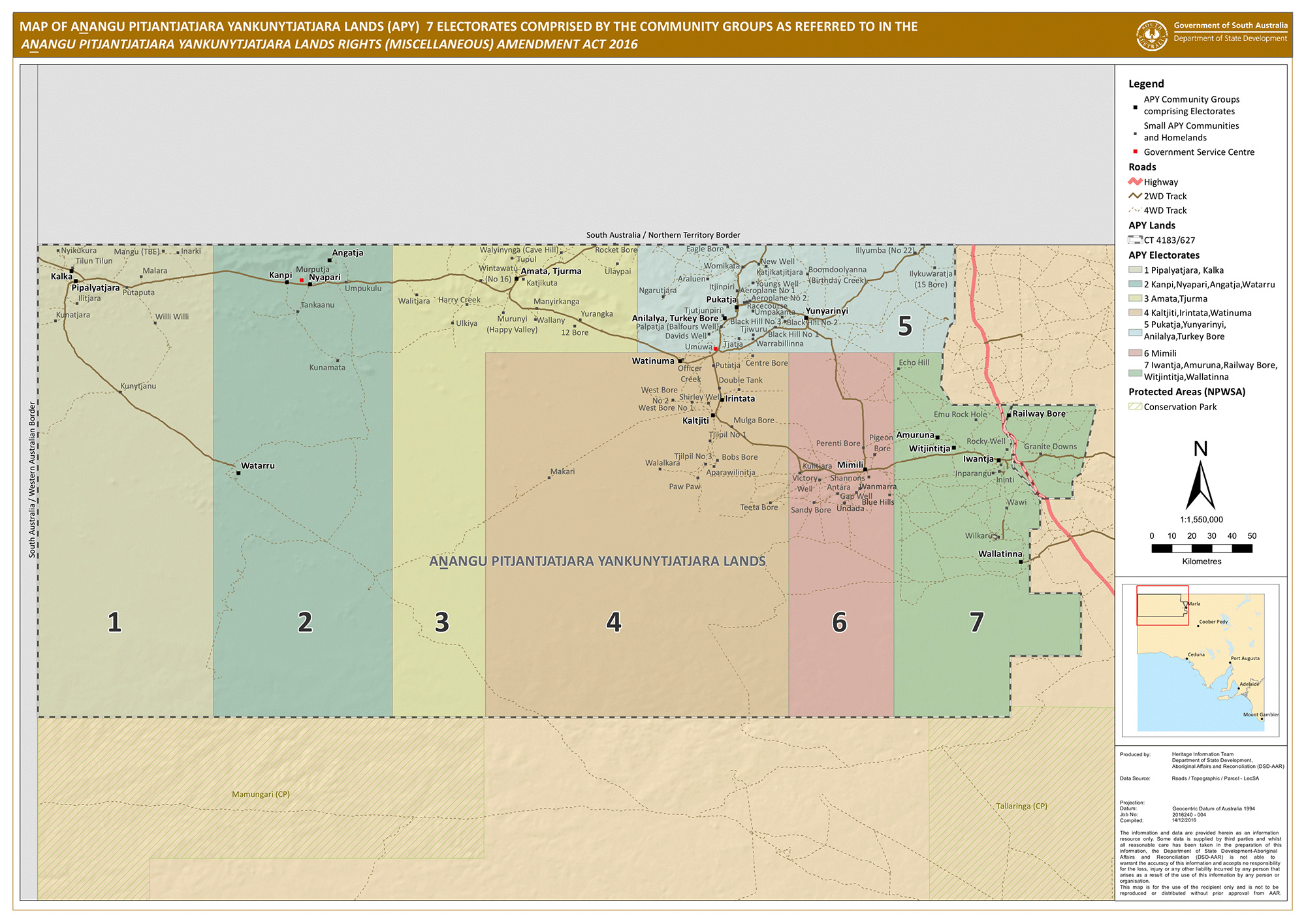 Figure 1: Map of the seven APY electorates
As with past electoral practices, the services of interpreters were engaged by ECSA to translate important election information into Pitjantjatjara language in support of the supplementary elections.
School principals were appointed as electoral officials to oversee the election process including managing the receipt of nominations and providing voting services on polling day.
Several in-language election posters were printed and dispatched for display in prominent areas within the electorates such as the Community stores, Community Council offices and Health Clinics to advertise and inform voters of the upcoming elections.
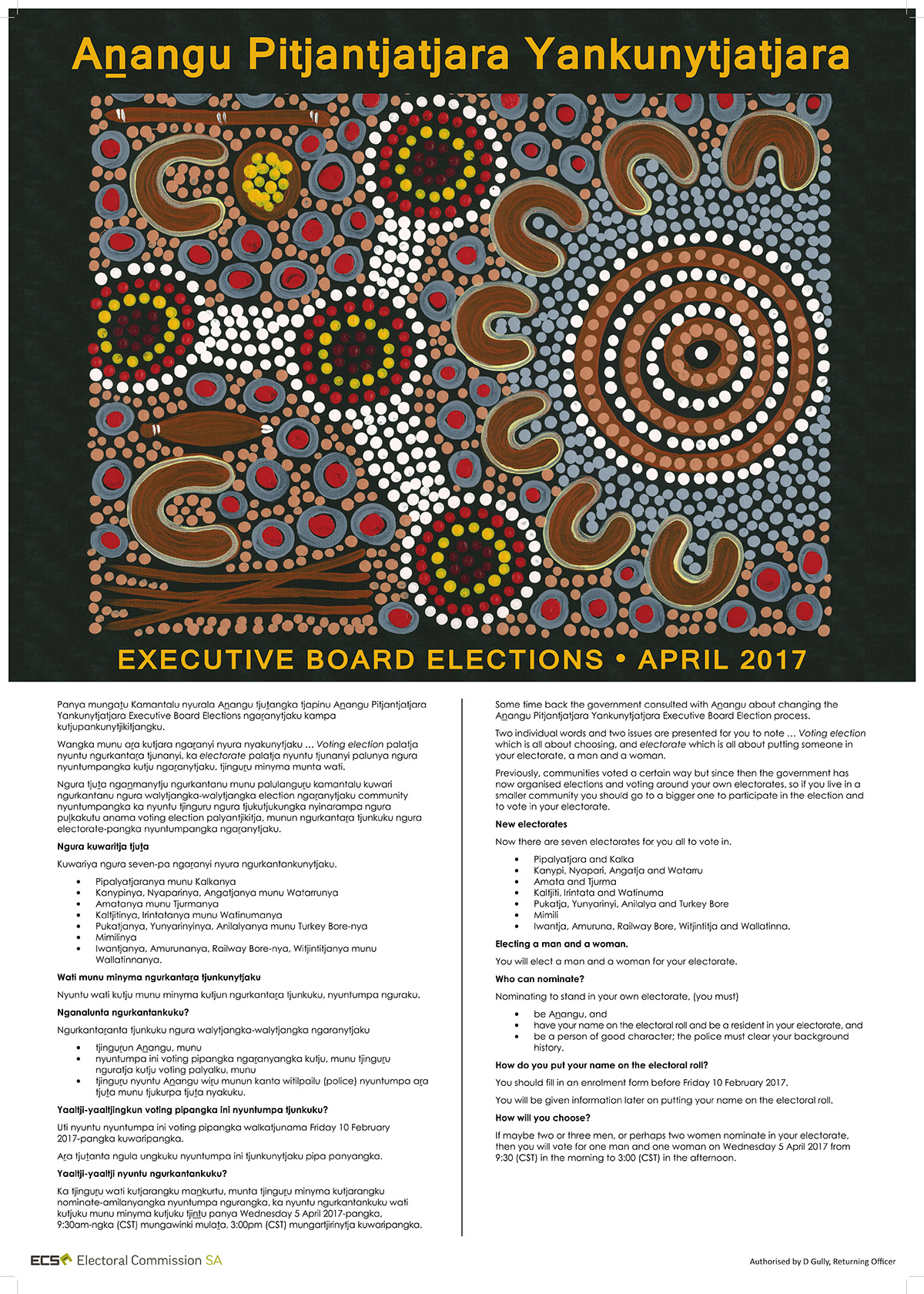 Figure 2: APY election poster
Voting for the APY Executive Board election was conducted between 9:30am and 3:00pm on Wednesday 5 April 2017.
Supplementary elections for three female members of the APY Executive Board also occurred during 2016-17 for the electorates of Mimili (1 female vacancy), Pukatja, Yunyarinyi,Anilalya, Turkey Bore
(1 female vacancy) and Iwantja, Amuruna, Railway Bore, Witjintitja, Wallatinna (1 female vacancy).
Following the close of nominations, candidate eligibility was checked, and it was determined that no voting was necessary to fill the supplementary elections.
APY Executive Board Election results 2017
| Electorate | Candidate Name | Results | No. of votes | Total votes | |
| Pipalyatjara and Kalka | Men | Richard Kanari | Elected Unopposed | ||
| Women | Sally Scales | Elected Unopposed | |||
| Kanypi, Nyapari, Angatja and Watarru | Men | David Miller | 7 | 31 | |
| Anton Baker | Elected | 24 | |||
| Women | Marita Baker | Elected Unopposed | |||
| Amata and Tjurma | Men | Frank Young | Elected | 46 | 89 |
| Owen Burton | 43 | ||||
| Women | Tjutjana Susan Burton | Elected Unopposed | |||
| Kaljiti, Irintata and Watinuma | Men | Wayne Ken | 5 | 38 | |
| Arnie Frank | 4 | ||||
| Murray George | Elected | 29 | |||
| Women | Mantuwa George | 1 | 37 | ||
| Nyukana Norris | Elected | 24 | |||
| Jennica Waye | 7 | ||||
| Veronica Burton | 5 | ||||
| Pukatja, Yunyarinyi, Anilalya and Turkey Bore | Men | Gary Lewis | 45 | 107 | |
| Trevor Adamson | 11 | ||||
| Donald Fraser | Elected | 51 | |||
| Women | Lois Fraser | Election Failed | |||
| Makinti Minutjukur | |||||
| Mimili | Men | Willy Martin | Elected Unopposed | ||
| Women | No Candidates | Election Failed | |||
| Iwantja, Amuruna, Railway Bore, Witjintitja and Wallatinna | Men | Ronnie Brumby | 24 | 55 | |
| Bernard Singer | Elected | 31 | |||
| Women | No Candidates | Election Failed | |||
| Total Votes | 357 | ||||
Other election services
Additional election services provided by ECSA during the period have included:
| Organisation | Date | Election Type | No of electors |
| Adelaide Festival Centre – Professional & Administration Enterprise Agreement ballot | July 2016 | Enterprise Agreement | 115 |
| Shine SA – Election of 2 Board Members | September 2016 | Board Members | 20 |
| Dept of Treasury and Finance – Enterprise Agreement ballot for Assistants to Members of the South Australian Parliament | September 2016 | Enterprise Agreement | 199 |
| Architectural Practice Board of South Australia - Election of 3 persons to the Board | November 2016 | Board Members | 709 |
Supplementary elections and casual vacancies
Supplementary Elections are held when it is necessary to fill a casual vacancy on a Council. The Electoral Commissioner assumes the role of Returning Officer for these elections.
Supplementary elections can be conducted either entirely by ECSA, or in partnership with the council.
During 2016-17, eleven supplementary elections were held, all of which were conducted entirely by ECSA.
Summary of Elections Conducted in 2016–17
| Council Name | Election | Ratio of Candidates | Number of Electors | Returned Ballot Material | Voter Turnout % | |
| Election Type | Date | to Vacancy | On Roll | Contested Elections | ||
| Clare & Gilbert Valleys Area Councillor |
11.07.2016 | 4:1 | 6600 | 6600 | 2252 | 38.3 |
| City of Whyalla Mayor |
08.08.2016 | 7:1 | 15221 | 15221 | 7102 | 46.7 |
| City of Mitcham The Park Ward |
12.09.2016 | 6:1 | 7162 | 7162 | 1902 | 26.6 |
| Adelaide Plains Council Lewiston Ward |
10.10.2016 | 4:1 | 2167 | 2167 | 319 | 14.7 |
| City of Tea Tree Gully Water Gully Ward |
10.10.2016 | 4:1 | 12378 | 12378 | 2183 | 22.7 |
| Southern Mallee District Council Bews Ward |
30.01.2017 | 1:1 | 756 | N/A | N/A | N/A |
| City of West Torrens Keswick Ward |
30.01.2017 | 4:1 | 5779 | 5779 | 1225 | 21.2 |
| Northern Areas Council Rocky River Ward |
06.03.2017 | 2:1 | 1154 | 1154 | 363 | 31.5 |
| District Council of Streaky Bay Eyre Ward |
06.03.2017 | 2:1 | 785 | 785 | 406 | 51.7 |
| City of Salisbury Levels Ward |
08.05.2017 | 8:1 | 12640 | 12640 | 2456 | 19.4 |
| City of Tea Tree Gully Balmoral Ward |
13.06.2017 | 9:1 | 11793 | 11793 | 2037 | 19.4 |
| TOTAL | 44635 | 43875 | 10675 | 27.9 | ||
Local Government Representation Reviews
Councils are required to conduct a representation review once during a period to determine if their community would benefit from an alteration to their current composition and structure. These reviews
are prescribed by the Minister for Local Government, but Council can also voluntarily undertake them at any time or as directed by the Electoral Commissioner.
The Electoral Commissioner is required to certify that the reviews have met the requirements for reviews set out in the Local Government Act 1999
During the reporting year nine local government representation reviews were submitted and certified.
| Council Name | Revised Structure |
| Kangaroo Island Council | Retain the principal member of Mayor, retain a no ward structure and nine area councillors. |
| District Council of Kimba | Retain the principal member of Chairperson (with the title of Mayor), retain a no ward structure and seven area councillors. |
| City of Campbelltown | Retain the principal member of Mayor, retain a ward structure of five wards with each ward represented by two councillors. Wards to retain the existing names of Hectorville, Gorge, Newton, River and Woodforde. |
| City of Mount Gambier | Retain the principal member of Mayor, retain a no ward structure and reduce the number of area councillors from ten to eight. |
| City of Port Lincoln | Retain the principal member of Mayor, retain a no ward structure and reduce the number of area councillors from ten to nine. |
| Berri Barmera Council | Retain the principal member of Mayor, retain a no ward structure and eight area councillors. |
| The Barossa Council | Retain the principal member of Mayor, retain a no ward structure and 11 area councillors. |
| District Council of Grant | Retain the principal member of Mayor, retain a no ward structure and 11 area councillors. |
| Southern Mallee District Council | Retain the principal member of Chairperson (with the title of Mayor) abolish the existing ward structure and reduce the number of elected members from nine to seven. |
During 2016-17, Adelaide Hills Council submitted a representation review, but failed to achieve certification. The Adelaide Hills Council have been asked to undertake corrective actions and re-submit their review.
The following ten councils submitted representation reviews prior to 30 June 2017 and are pending assessment:
| Northern Areas Council | City of Salisbury |
| City of Playford | City of Port Adelaide Enfield |
| District Council of Yankalilla | Clare & Gilbert Valleys Council |
| City of Victor Harbor | District Council of Barunga West |
| City of Norwood Payneham & St Peters | District Council of Loxton Waikerie |
A further 17 councils have commenced representation reviews with a final gazettal date of 12 December 2017.
| District Council of Ceduna | District Council of Cleve |
| District Council of Coober Pedy | Copper Coast Council |
| District Council of Karoonda East Murray | Kingston District Council |
| District Council of Lower Eyre Peninsula | Naracoorte Lucindale Council |
| District Council of Orroroo Carrieton | City of Onkaparinga |
| District Council of Peterborough | City of Port Augusta |
| Renmark Paringa Council | City of Tea Tree Gully |
| District Council of Tumby Bay | Corporation of the Town of Walkerville |
| City of Whyalla |
Enforcement of compulsory voting
Under section 85 of the Electoral Act 1985 an elector must not fail to vote without a valid and sufficient reason or fail to respond to the Notice provided by the Electoral Commissioner. This Apparent Failure
to Vote Notice is sent by the Electoral Commissioner, within 90 days after the close of the election, to electors who appear to have not voted at an election under the Electoral Act 1985.
If an electors does not respond to the apparent failure to vote notice or provides an invalid reason as to why they did not vote, they are issued with an expiation notice. This is followed up with an expiation
reminder notice with a late fee if it is still unpaid. All outstanding expiated offences are then sent to the Fines Enforcement and Recovery Unit (FERU) within the Attorney-General’s Department. FERU take
enforcement action and can restrict vehicle registration, suspend driver’s licenses and garnish money from bank accounts. There are currently 9,001 fines pertaining to the 2014 State Election and 449 fines
pertaining to the 2014 Fisher and 2015 Davenport by-elections currently outstanding.
The 2016–17 year also saw minimal failure to vote activity relating to previous state elections and by-elections. These numbers are not reported.
Funding and Disclosure
Online lodgement system
A large part of election planning has involved working with developers to develop an online lodgement system to help stakeholders with their lodgement obligations. ECSA aims to have an online lodgement system available by January 2018.
Disclosures
Half-yearly disclosures were lodged in July 2016 and January 2017 (relevant entity returns and donor returns). Stakeholders are becoming more familiar with the process as they complete each half-yearly lodgement cycle and there have been no issues with lodgements over the past year.
Special assistance funding
Valid special assistance funding claims were received from the eligible parties for both half yearly periods, resulting in just under $230,000 being paid out for these claims during the 2016–17 financial year.
Reciprocal arrangements with electoral commissions
Pre-poll voting facilities were provided for six Electoral Management Bodies (EMBs) during the reporting year. A reciprocal arrangement between EMBs allows electors travelling outside their home State to cast their vote at a State or Territory electoral office whenever a by-election, referendum or general election is held in their absence.
The following table shows the election activity for 2016–17:
Interstate Elections 2016–17
| Jurisdiction | Election Date | Type | Chamber | District/Division | No. of votes issued |
| Queensland | 16.07.16 | By | Legislative Assembly | Toowoomba South | Nil |
| Northern Territory | 27.08.16 | GE | Legislative Assembly | 52 | |
| Australian Capital Territory | 15.10.16 | GE | Legislative Assembly | 42 | |
| New South Wales | 12.11.16 | By | Legislative Assembly | Canterbury, Orange, Wollongong | Nil |
| Western Australia | 11.03.17 | GE | Legislative Assembly | 183 | |
| New South Wales | 08.04.17 | By | Legislative Assembly | Gosford, Manly, North Shore | Nil |
| Tasmania | 06.05.17 | GE | Legislative Council | Launceston, Murchison, Rumney | 2 |
| By = By-election, Ref = Referendum, GE = General election | |||||
WA secondments
ECSA has an arrangement with other Electoral Management Bodies where staff are seconded to other states’ major electoral events to gain valuable experience and provide specialist advice and support. Two ECSA staff were seconded to the Western Australian Electoral Commission (WAEC) to work at the Western Australian State General Election held on 11 March 2017.
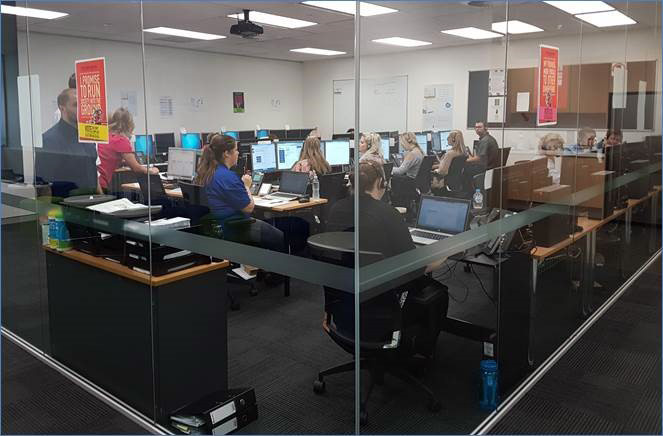
One staff member spent six weeks as a supervisor in the WAEC call centre where they gained valuable insight into how an election call centre is managed. This included the provision of staff, training methodologies, and observation of day-to-day duties, challenges and escalations. The handling of large call volumes and rostering of staff was also closely monitored.
The other staff member worked as a supervisor at the WAEC Declaration Vote Processing Centre. Both ECSA staff reported that their secondment experience was a valuable development opportunity and will, where appropriate, lead to the incorporation of several ideas and processes into ECSA business operations.
Community awareness and information
Under section 8(1)(c) of the Electoral Act 1985, ECSA is required to ensure that the public is adequately informed of their democratic rights and obligations. To meet these legislative requirements ECSA undertakes various community and stakeholder engagement activities including annual attendance at the Tauondi College Open Day, and its long-term commitment and sponsorship to Youth Parliament. Ongoing consultative stakeholder engagement allows ECSA to assess its current and future projects through community feedback and participation.
In addition, ECSA has embraced the state government’s Digital by Default Declaration in using digital technologies to provide online, mobile-ready, easy to use and accessible services. The website is ECSA’s primary communication tool for the delivery of information on all aspects of electoral matters.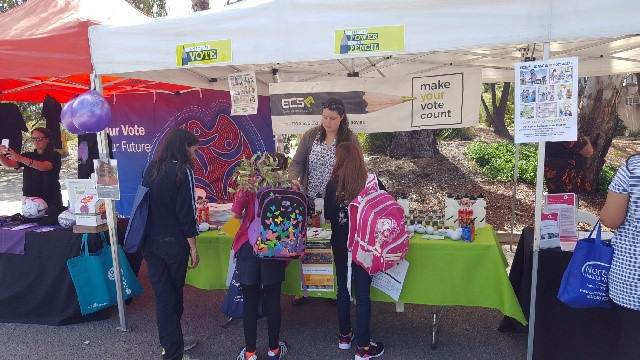
Community engagement
Youth Parliament
ECSA continued to work with the YMCA through sponsorship and support for Youth Parliament. We take pride in continuing to promote the value of democracy to the youth of South Australia
APY Lands
The Anangu Pitjantjatjara Yankunytjatjara Land Rights (Miscellaneous) Amendment Act 2016 resulted in significant legislative amendments being introduced for the conduct of elections for the Anangu Pitjantjatjara Yankunytjatjara (APY) Executive Board. The legislative changes support gender balance representation on the APY Board with each electorate requiring a male and a female representative to be elected. Eligibility to stand for election to the Executive Board and to vote in the elections require enrolment on the State electoral roll. Further eligibility requirements for prospective candidates now require the introduction of criminal history checks as a test of suitability to serve on the Executive Board.
The APY elections saw the introduction of electronic voting through ‘touch-screen’ computer technology with electors being able to select the male and female candidate of their choice by touching their photo on a large format screen. The new system was well received and provided the opportunity to introduce voting across each of the seven electorates within the APY Lands, as required under the amended legislation. The electronic voting system also provided the ability for electoral officers to visit hospitals in Adelaide and Alice Springs to enable Anangu located outside the APY Lands to participate in their Executive Board elections. Information briefings were delivered to the Aboriginal Lands Parliamentary Standing Committee, the Minister for Aboriginal Affairs and Reconciliation, officers of the Department of Aboriginal Affairs and Reconciliation and through the Paper Tracker radio program. The briefings provided updates on the changes in the electorates; male and female positions; eligibility for candidacy and voting; and the electronic voting system.
A two-day workshop in Umuwa was conducted to provide information and training on the new nomination processes and ‘touch-screen’ voting system to principals and school workers. ECSA attended and convened several events, meetings and workshops during 2016-17 including the following;- The federal election visitor program provided valuable understanding of the changes to the Senate voting system which have flowed through to the Legislative Council election.
- The launch of the ‘Democracy Machine’ and opening ceremony at the Migration Museum.
- Attendance at the National Annual Disability Access Committee meeting in Canberra provided valuable opportunities to engage with stakeholders and to gain further insight into expectations.
Community engagement events
- Tauondi College Open Day – 27/10/16
- NAIDOC Family Fun Day – 11/7/16
- 2016 Youth Parliament
Consultative stakeholder engagement meetings
- Aboriginal and Indigenous people
- Blind and vision impaired
- Multicultural stakeholders
- Youth sector
Going forward, ECSA is looking at redesigning the agency’s website and engaging with the community through an active social media strategy.
Promoting a healthy and safe work environment
ECSA is committed to the South Australian Government’s Work Health and Safety strategies and initiatives and aims to fulfil all legislated obligations under the Work Health and Safety Act 2012 and associated regulations.
Wellness and engagement
ECSA values its employees and is committed to providing a safe and supportive workplace with systems of work that ensure that all staff are safe from injury and risks to their health while they are at work.
WHS-related information is regularly disseminated to all staff, via discussions, meeting minutes and direct emails. Additionally, ECSA provides work place safety reference materials and health and safety initiatives that are accessible to staff at all times, including:
- SafeWork SA ‘stretching your productivity’ desk card
- Ergonomic Mesh Chair adjustment instructions
- Emergency Procedures
- Annual influenza vaccination program
- Employee Assistance Program
- WHS & IM policy fact sheets
- SafeWork SA publications.
Risk Management
ECSA understands the importance of risk management as a planning tool and is committed to ensuring that agency management systems integrate safety and wellbeing planning into all operations.
A small number of facilities-related issues were raised by ECSA staff during the 2016-17 year. These were addressed immediately where possible or referred to building management for action. ECSA’s Leadership Group and WHS Committee review incidents and follow up on outcomes in keeping with the commitment to continuous improvement. Staff are kept informed of actions being undertaken.
Work Health and Safety Workshops and Training
In 2016-17 the following WHS aligned activities were undertaken:
- CPR Training with St John
- EAP introduction session & promotion of services
- Training on Duress alarm and fire alarm procedures.
WHS Risks
ECSA conducts regular WHS audits and inspections of the facilities and staff are encouraged to be proactive about reporting risks in the workplace. ECSA is committed to ensuring that any identified issues are investigated and dealt with promptly.