
Voting
How-to-vote cards (HTVCs) are created by political parties, groups, or independent candidates to show the order in which they prefer you to number your ballot papers. You can choose to follow them or vote entirely according to your own preferences. There are 2 types of HTVCs used in South Australian elections:
- Cards lodged for display in polling places and early voting centres.
- Cards lodged for distribution by individuals or campaign workers during the election period.
HTVCs at polling places
Political party and candidate workers may stand outside polling places offering HTVCs that show how they would like you to vote. You do not have to take these cards.Anyone distributing a HTVC during the election period must ensure it is substantially the same as the version lodged with the Electoral Commission of South Australia.
👉 Learn more detailed information about HTVCs.
The way to complete your ballot papers is different at each type of election in South Australia.
On this page you can find instructions on how to complete your ballot paper correctly at each election.
State elections and by-elections
When voting in a state election you will be given 2 ballot papers: a small green paper for the House of Assembly, and a large white paper for the Legislative Council. At a by-election, you will just be given a green House of Assembly ballot paper.
House of Assembly
On the green House of Assembly ballot paper, you need to number every square in the order of your choice.
- Write the number 1 in the square next to the candidate who is your first choice
- Write the number 2 next to your second choice
- Continue by placing the numbers 3, 4, 5 and so on until you have a number in every square.
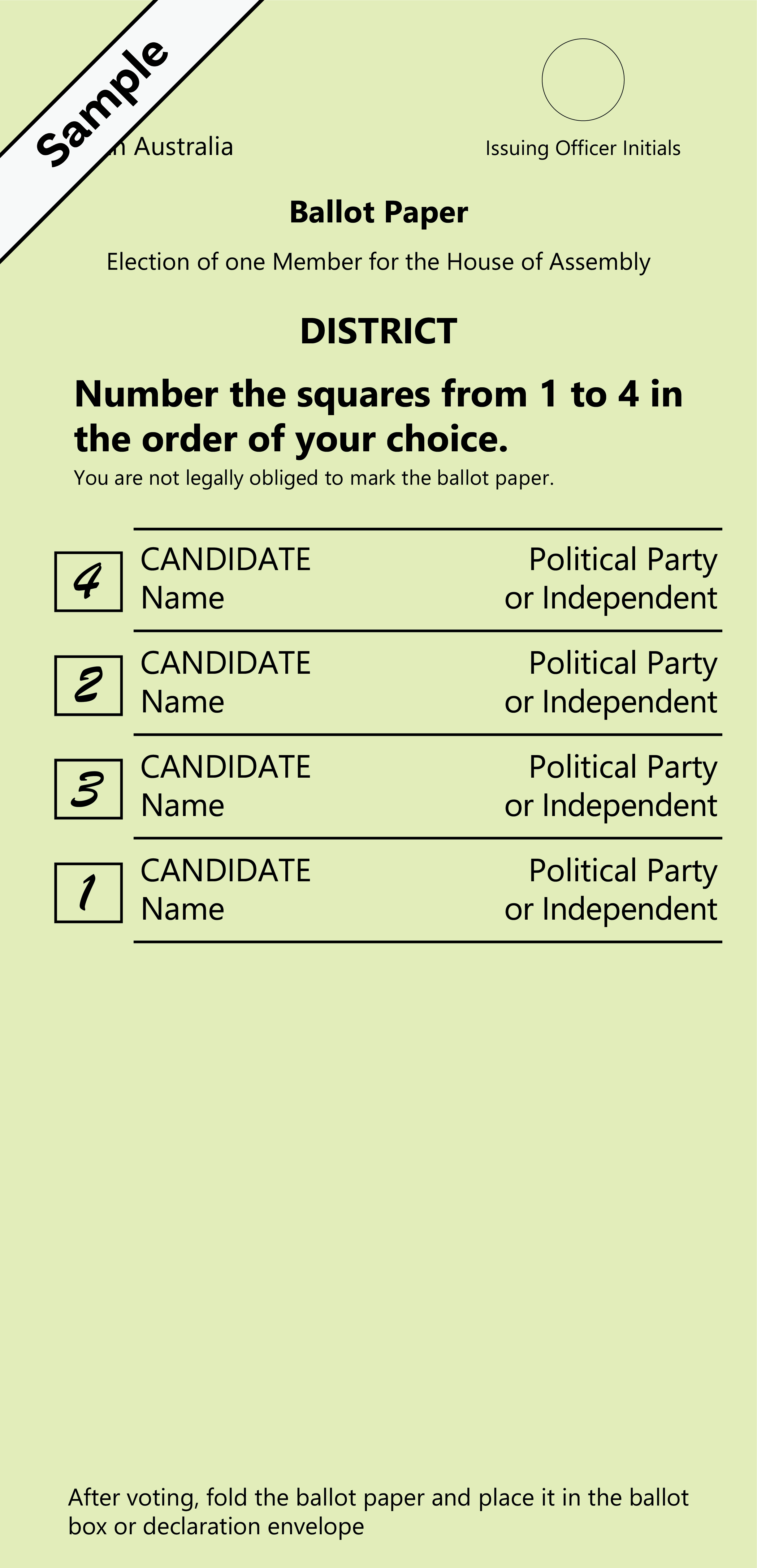
If you need assistance or make a mistake please see an electoral officer.
You can practice making a formal vote by using our interactive ballot paper below:
House of Assembly practice ballot paper >>
Legislative Council
On the white Legislative Council ballot paper, there are 2 ways you can vote. Either above the black line or below the line - but not both.
Vote above the black line:
If you choose to vote above the black line:
- Write the number 1 in the square next to the party or group of candidates which is your first choice.
- You can then write the number 2 next to your second choice, and so on for as many parties or groups of candidates as you like. You do not need to number every square.
- Leave the rest of the ballot paper blank. Do not mark below the black line.
By voting above the black line, your vote will go to the candidates within the group (or groups) you have chosen.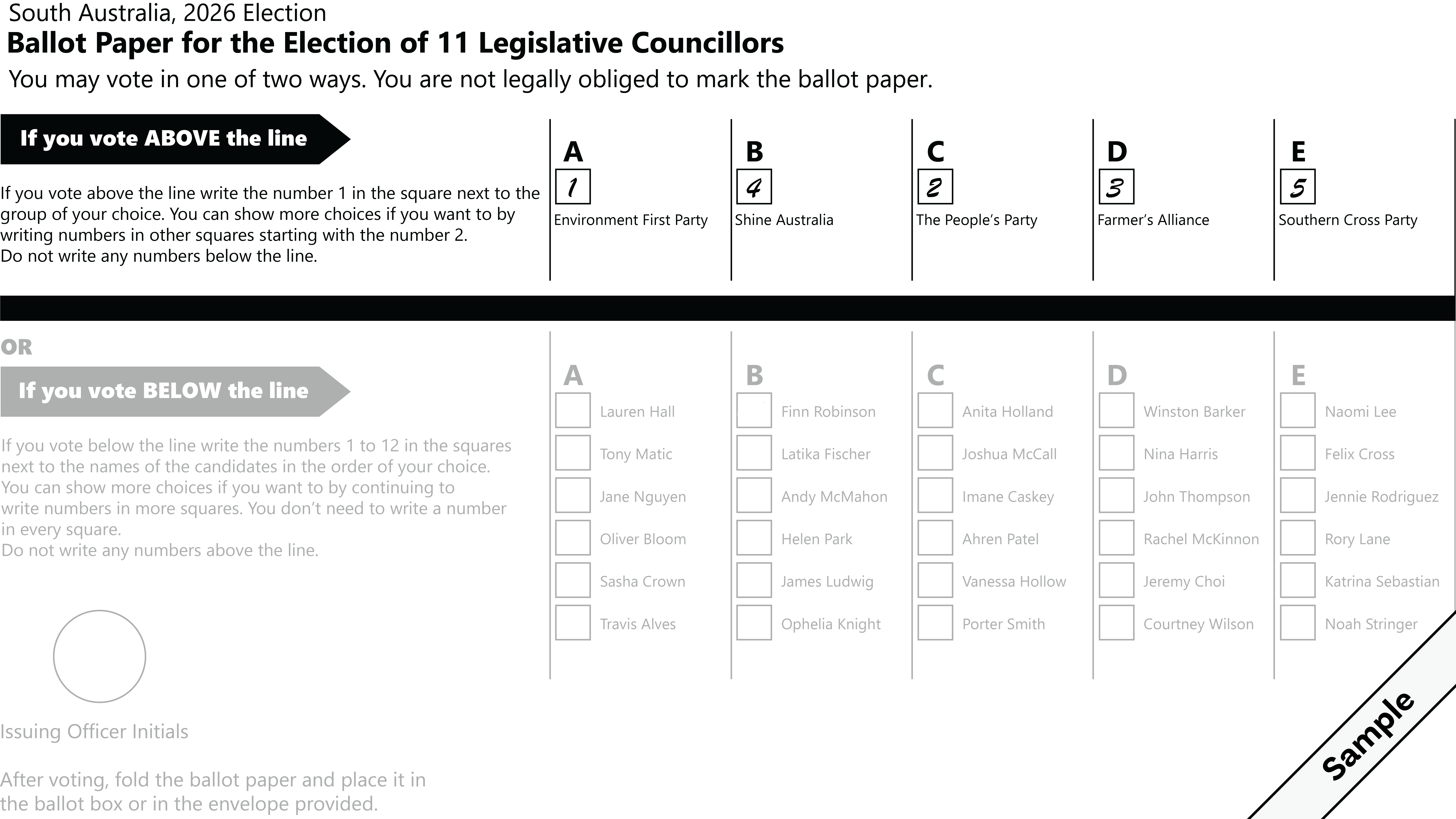
Vote below the black line:
If you choose to vote below the black line:
- Write the number 1 in the square next to the candidate who is your first choice.
- Continue by placing the numbers 2, 3, 4, 5, 6 in the squares next to the other candidates of your choice until you have chosen a minimum of 12 candidates.
- You may choose to continue numbering more than 12 candidates.
By voting below the black line, you are deciding the order of candidates according to your preferences.
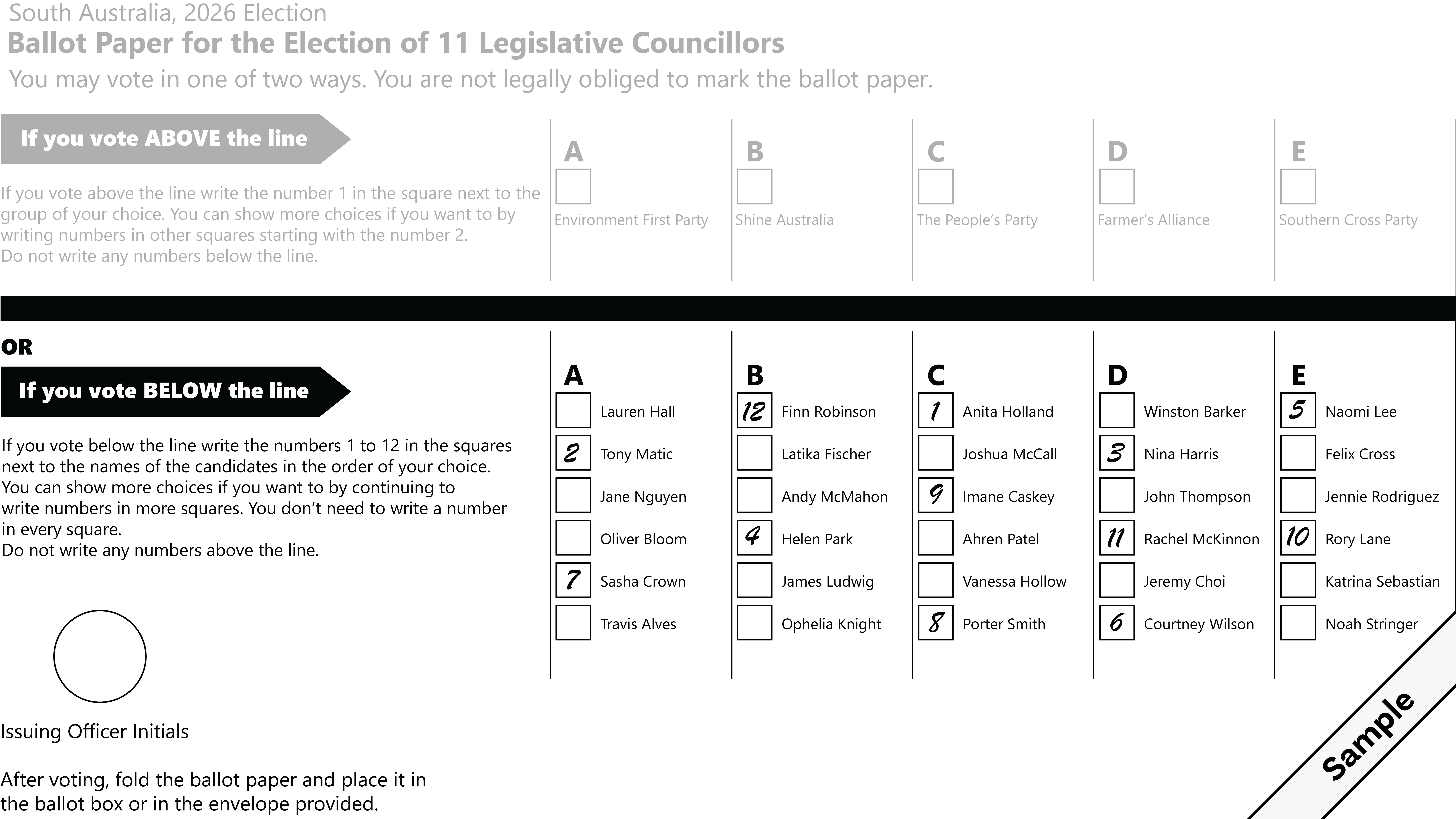
If you make a mistake, don't worry. Put a line through the mistake and write the correct information beside it, or you can ask an electoral officer for a replacement ballot paper.
You can practice making a formal vote by using our interactive ballot paper below:
Legislative Council practice ballot paper >>
SA First Nations Voice to Parliament election
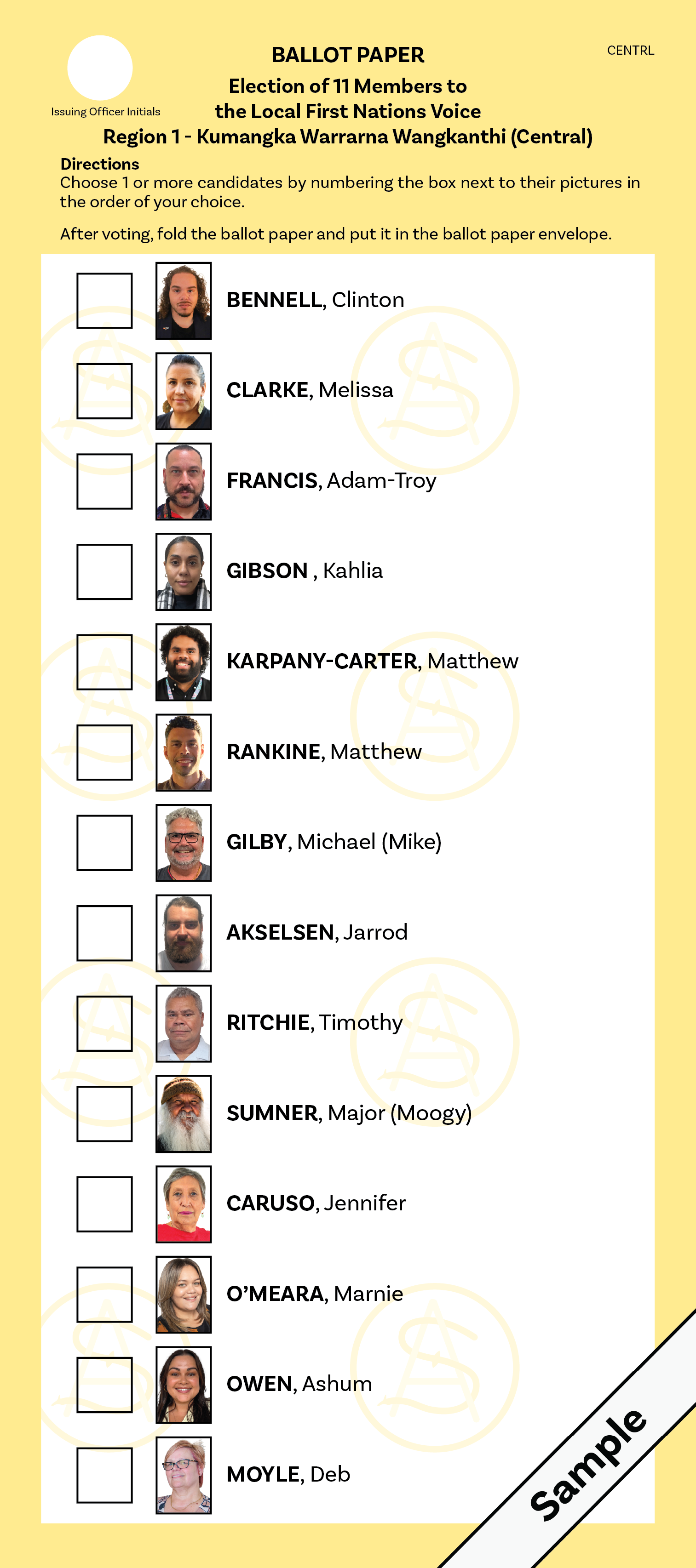
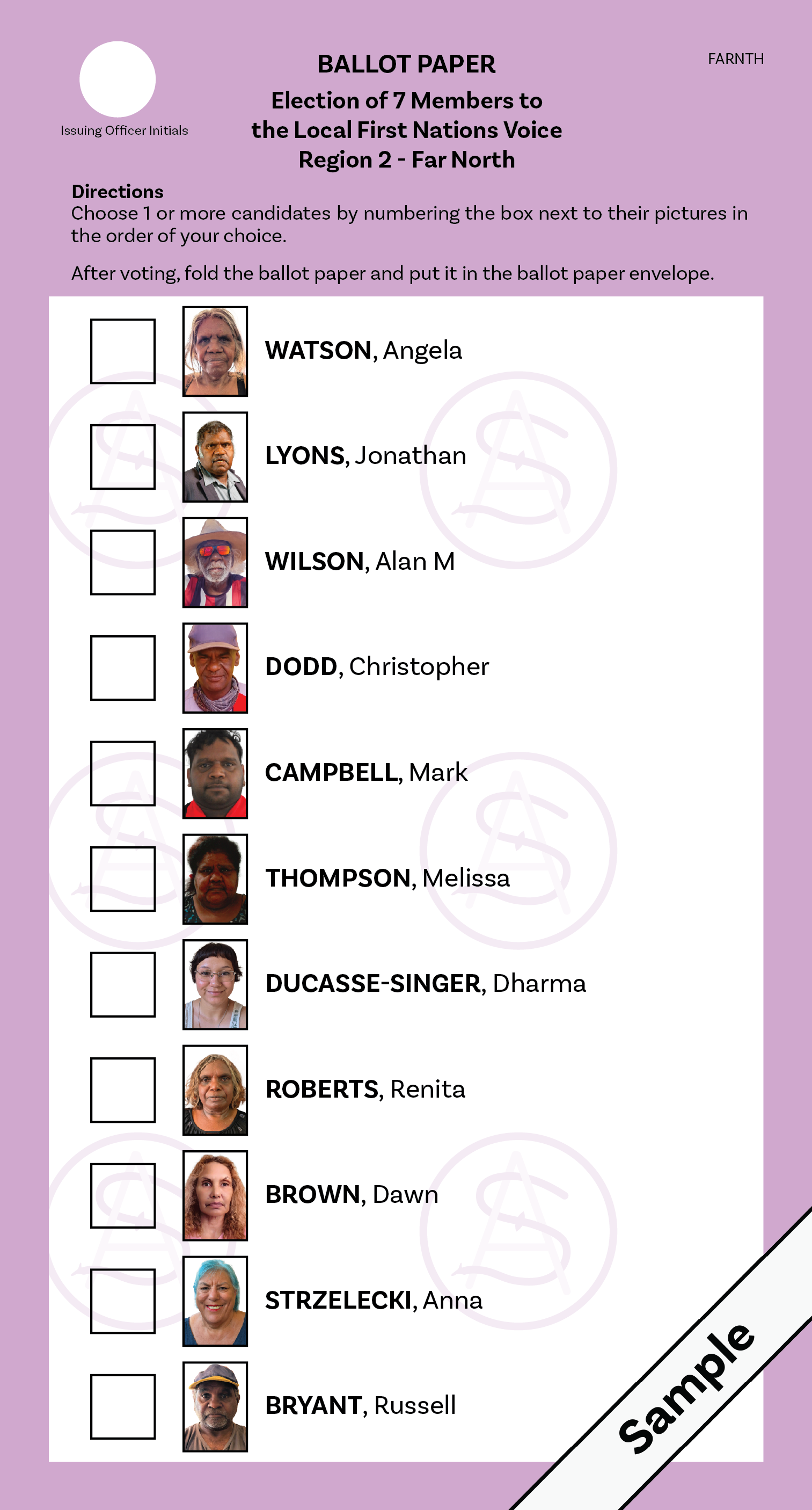
When voting at a SA First Nations Voice to Parliament election you will be given a ballot paper showing all the candidates for your region.
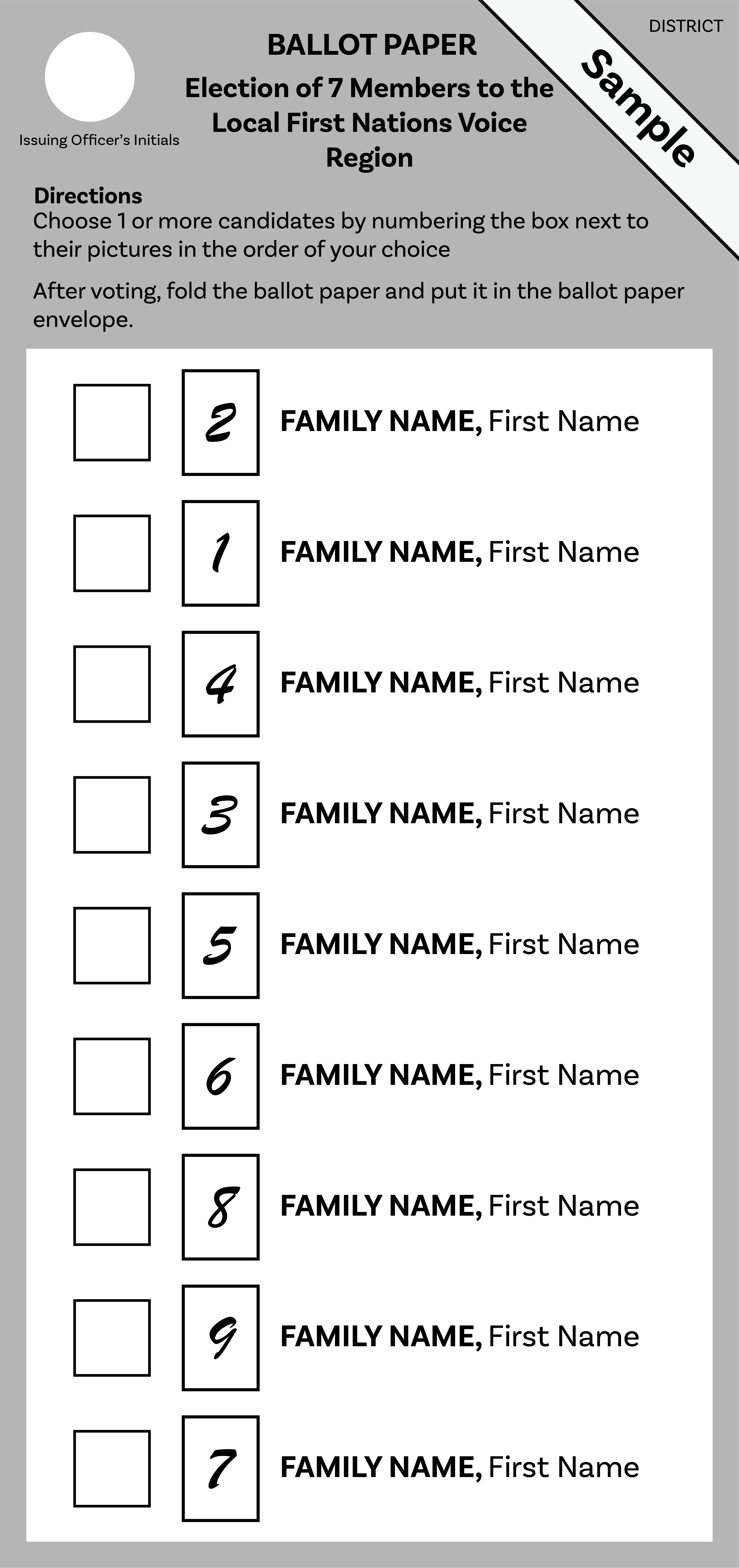
To vote, you must write a number 1 in the box next to the name and photo of the candidate who is your first choice.
If you want to, you can vote for more candidates. Write the number 2 in the box next to the candidate who is your second choice, the number 3 in the box next to the candidate who is your third choice and so on.
Continue on until you have voted for all the candidates you want to.
You don’t have to number every box.
Remember, it’s your choice how many candidates you vote for.
You don’t have to vote for more than 1 candidate, but your SA First Nations Voice to Parliament will have 7 or 11 elected representatives, so it is a good idea to vote for multiple candidates to represent you. If you only vote 1, your vote can only help one candidate to get elected. The more candidates you vote for, the more you can help your preferred candidates get elected.
|
|
|
|
|
|
|
|


More information
Download a copy of our easy read guide on voting at state elections (PDF, 1.5MB)
Download a copy of our easy read guide on voting in a by-election (PDF 2.64MB)
Voting in South Australian elections is compulsory. If it appears you did not vote, the Electoral Commission SA (ECSA) is required by law to contact you.
At any stage you can provide a valid and sufficient reason for not voting and the process will stop.
Keeping your enrolment details up to date, including your email address and mobile number, is the best way to receive reminders about upcoming elections.
Overview of the non-voter process
If you appear not to have voted, you may receive up to 3 notices under section 85 of the Electoral Act 1985 and the Expiation of Offences Act 1996.
If you do not respond or resolve the matter, it will be referred to the Fines Enforcement and Recovery Unit (FERU).
Apparent failure to vote notice (First notice)
When it is sent:
Within 90 days after the election, to the address on the electoral roll at the close of rolls.
What you must do:
- Complete the form
- Have it witnessed (any adult can witness it)
- Return it by reply-paid post or scan and email to
This email address is being protected from spambots. You need JavaScript enabled to view it. - Ensure it is received by ECSA by the due date
Important:
- Not responding to this notice is an offence.
- Reasons cannot be accepted or rejected over the phone.
- If you reason is accepted, no further action is required.
Expiation notice - $115 (Second notice)
You will receive this notice if you:
- Did not respond to the first notice, or
- Did not provide a valid and sufficient reason.
Fee breakdown:
- $10 expiation fee
- $105 Victims of Crime Levy
Your options:
- Pay the fine
- Enter into a payment arrangement
- Elect to be prosecuted (matters are dealt with in court)
- Apply for a review of the expiation notice
You may still provide a valid reason and stop the process.
Expiation reminder notice - $190 (Third notice)
If you fail to respond to the first 2 notices, you will receive a reminder notice.
Includes:
- Original fine
- $75 reminder fee
Your options:
- Pay the fine
- Enter a payment arrangement
- Elect to be prosecuted
- Apply for a review
You may still provide a valid reason at this stage.
Referral to the Fines Enforcement and Recovery Unit
If, after 3 notices, you still:
- Have not paid the fine, and
- Have not provided a valid reason
... the matter will be referred to the Fines Enforcement and Recovery Unit (FERU).
FERU may apply additional penalties and enforcement measures.
Possible enforcement actions include:
- Driver's licence suspension
- Salary or bank account deductions
- Clamping or impounding vehicles
- Seizing and selling assets
Contact the Fines Enforcement and Recovery Unit on 1800 659 538 or visit Fines SA.
How to pay your fine (before enforcement)
You will need your expiation notice, which includes your unique identification number.
Payment options:
- BPAY
- Credit card
- Over the phone
- In person
- Apply for a payment arrangement with FERU.
If you have misplaced your notice, contact ECSA.
Contact the Electoral Commission SA
Phone:
- 1300 655 232 (within SA)
- 08 7424 7400 (interstate)
- +61 8 7424 7400 (overseas)
Email:
Address:
Level 6, 60 Light Square, Adelaide SA 5000 (Find us on the map using this link)
Postal:
Electoral Commission SA
GPO Box 2072
Adelaide SA 5001
(No stamp required)
Paying an overdue fine
Once FERU has taken over enforcement, ECSA cannot accept payments.
FERU payment options include:
- Online
- Telephone
- Australia Post
- Services SA Customer Service Centres
- Payment arrangements for longer-term repayment
To assist you to prepare for your day, the following page can be printed or here, linked, is a PDF to download, print and complete
 |
My state election summary voting plan for [ insert date ]
|
To prepare my state election voting plan, I will need to consider
My plan to vote has been completed by [ Me ] [ Family Member ] [ Carer ] [ Friend ]
My state-election-voting-day is [ insert date ] (between 14 March and 21 March)
My electoral district → Check my district
My polling places → Check where I am going to vote
Who I am going to vote for
I can learn about candidates by reading the newspaper, watching trusted news sources on TV or looking at the candidate's website. How to Vote cards can be accepted at the polling location, however you are under no obligation to accept them.
Who is my support person
I can choose to have support from someone I trust when I vote. This can be the person who helped me fill in this form or someone else.
My voting support person is [ insert name ]
What happens when I get to the polling location
If I need a polling official to come out to me in my car for me to cast my vote, this can be arranged on my arrival.
When I vote, my name is marked off the roll electronically. This confirms that I have voted. If I received my easy vote card in the mail, this will be helpful to show at this stage as it contains a unique QR code with my details.
I will be asked 3 questions by a polling official. I will need to answer these before I can receive my ballot papers to vote:
- What is your full name?
- What is your address?
- Have you voted before in this election?
- *you may be asked other questions to assist polling officials
To help answer these questions I can write my answers down in a safe place and bring it with me. This information is private and I decide who I share this with.
If I would like to also vote in the South Australian First Nations Vote to Parliament, I need to make the polling official aware when I arrive. I will be given an extra ballot paper to cast my vote in this election.
Other ways I can vote
If I can’t get to a polling location, I might be eligible to apply for a postal vote, or I will use Telephone Assisted Voting.
If I am in hospital, I can still vote.
Phone numbers I can call
- Phone: 1300 655 232 within South Australia
- Phone: (08) 7424 7400 from interstate
- Phone: +61 8 7424 7400 from overseas