
Elections
- Details
| Area Councillor (2 vacancies) | |
|---|---|
| Due to the resignation of a member of the Council, and an existing Councillor vacancy, a supplementary election was held in June 2021 to fill two vacancies for Area Councillor for Copper Coast Council. |
| Election summary | |
|---|---|
|
Five candidates contested the election, and on Thursday 17 June 2021 Peter SIMS and Sandra Marie PADDICK were declared elected. Detailed election results and other information about the election can be found below. |
| Timetable | |
|---|---|
| Roll close | 5pm, Wednesday 31 March 2021 |
| Opening of nominations | Thursday 22 April 2021 |
| Nominations close |
12 noon, Thursday 6 May 2021 |
| Dispatch of ballot material to electors | Wednesday 26 May 2021 to Tuesday 1 June 2021 |
| Close of Voting (Polling Day) | 12 noon, Tuesday 15 June 2021 |
| Scrutiny and count |
From 1pm, Thursday 17 June 2021 |
| Candidates |
|---|
| At the close of nominations at 12 noon on Thursday 6 May 2021, a total of five (5) nominations were received and accepted for the supplementary election. In accordance with the Local Government (Elections) Act 1999, a draw was held after the close of nominations to determine the order in which names of candidates would appear on the ballot paper and the result of the draw was as follows:
Profiles of each of these candidates are available by clicking their names above. |
| Daily Returns |
|---|
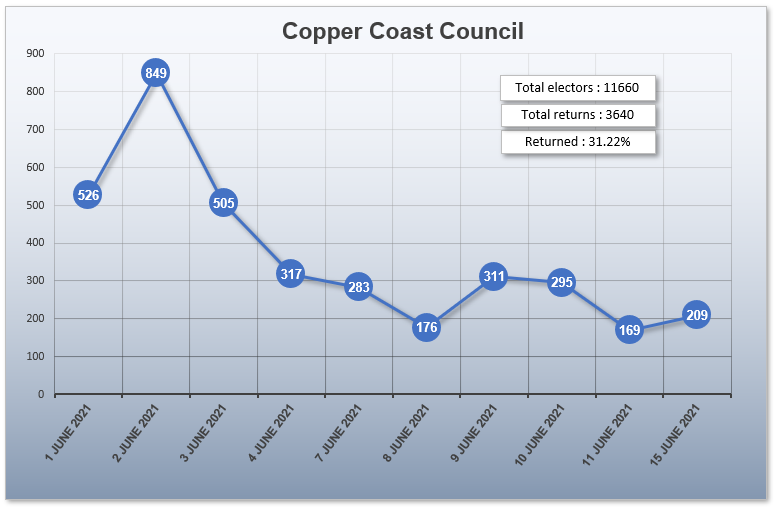 |
| Count Summary | |
|---|---|
| Enrolled voters | 11660 |
| Envelopes returned | 3640 |
| Envelopes accepted |
3545 |
| Ballot papers not returned in envelope | 0 |
| Voter participation | 3640 (31.22% of the total enrolment) |
| Formal votes |
3488 |
| Informal votes | 57 |
| Quota | 1163 |
| First preference votes | ||
|---|---|---|
| Below are the first preference votes received by the candidates in the order they appeared on the ballot paper. Percentages have been rounded to two decimal places. | ||
| Candidate | First preference votes | Percentage |
| DAYMAN, Charmaine | 635 | 18.21% |
| SIMS, Peter | 1106 | 31.71% |
| MILLER, Mark | 230 | 6.59% |
| BELL, Su | 745 | 21.36% |
| PADDICK, Sandra Marie | 772 | 22.13% |
| Distribution of preferences |
|---|
|
As Peter SIMS and Sandra Marie PADDICK each obtained a number of votes greater than the quota of 1163 they have been declared elected. To view the distribution of votes refer to the Copper Coast - Area Councillors (FINAL) 17 June 2021 (XLS 82 KB) |
- Details
A referendum allows eligible electors to express an opinion on adopting or changing public policy issues or their constitution. In Australia, referenda are initiated by the Commonwealth, State or Territory parliaments.
Like general elections, voting in referenda is compulsory for all enrolled electors.
Australia's first ever referendum was held in South Australia in 1896 and dealt with matters relating to secular and religious education. Following the success of the South Australian referendum the process was then adopted countrywide at both State and Federal level.
The process for enacting a State referendum is as follows:
- A Bill containing the proposed changes is laid before, and discussed by, both houses of Parliament.
- After the Bill passes through Parliament, the electorate votes on the issue at a referendum.
- If a majority of voters at the referendum approve of the Bill, it may be sent to the Governor for official consent and may become law.
State referenda have included issues debated by Parliament such as daylight saving, trading hours for shops, and the closing time for pubs. The table below shows some of the referenda held in South Australia, including their results.
| Date | Proposal | Votes in favour | Votes not in favour |
Passed |
|
29/04/1899 |
'Are you in favour of the Amended Commonwealth Bill?' 'Are you in favour of extending the franchise for the Legislative Council to all householders as provided by the Bill passed by the House of Assembly in 1898?' |
65,990
49,208 |
17,053
33,928 |
YES
YES |
|
26/04/1911 |
'Are you in favour of increasing the payment of Members of Parliament to Three Hundred pounds per annum?' |
42,934 |
89,042 |
NO |
|
20/11/1965 |
‘Are you in favour of the promotion and conduct of Lotteries by the Government of the State?’ | 344,886 | 142,196 | YES |
|
19/09/1970 |
‘Are you in favour of shops in the Metropolitan Planning Area and the Municipality of Gawler being permitted to remain open for trading until 9 pm on Fridays?’ | 177,296 | 190,826 | NO |
|
06/11/1982 |
‘Are you in favour of Daylight Saving?’ | 568,635 | 225,310 | YES |
| 09/02/1991 | ‘Do you approve the Constitution (Electoral Redistribution) Amendment Bill, 1990?’ | 649,906 | 197,244 | YES |
More information can be found in the publication South Australian referenda (PDF 818 KB)
- Details
First preference and two-candidate preferred
Final distribution of preferences
- Details
City of Port Augusta, Mayor, 9 September 2013 (PDF 13 KB)
Tatiara District Council, East Ward, 8 July 2013 (PDF 12 KB)
District Council of Streaky Bay, Flinders Ward, 8 July 2013 (PDF 12 KB)
Wudinna District Council, Area Councillor, 11 June 2013 (PDF 6 KB)
Wattle Range Council, Corcoran Ward, 11 June 2013 (PDF 6 KB)
Tatiara District Council, Poll, 3 June 2013 (PDF 7 KB)
District Council of Streaky Bay, Flinders Ward, 15 April 2013 (PDF 12 KB)
City of Mitcham, Babbage Ward, 15 April 2013 (PDF 14KB)
Northern Areas Council, Yackamoorundie Ward, 12 March 2013 (PDF 6 KB)
City of Mitcham, The Park Ward, 29 January 2013 (PDF 14 KB)
City of Murray Bridge, Monarto Ward, 29 January 2013 (PDF 15 KB)
Note: If you have problems accessing or reading these documents you can request a copy be made available to you in an alternative format.
- Details
A Writ is the legal instrument or official document authorising an election to be held for representatives to serve in the Parliament. In South Australia, Writs are issued for:
- Legislative Council and House of Assembly general elections
- House of Assembly by-elections for casual vacancies caused by the death or resignation of a member, or for another reason (see the By-elections page for more information).
The Writ outlines the timeframe for the election, including deadlines for:
- Enrolling to vote
- Lodging nominations
- The Writ to be returned
The Writ fixes a day for polling day (if there are more nominations than vacancies).
The dates can be deferred in certain circumstances, but by no more than 21 days. Beyond that date, or if an election partially or wholly fails, a new Writ must be issued.
The Electoral Act 1985 allows one multi-district Writ to be issued authorising general elections in all House of Assembly districts. Previously, separate Writs were issued for each district election.
Individual Writs continue to be issued for the Legislative Council election and any lower house by-election. The Electoral Act 1985 also introduced a separate date for the close of the electoral rolls following Writ issue.
Amendments to the Electoral Act 1985 introduced in 2013 require that for general elections the Writ must be issued 28 days before the date fixed for polling.