
About ECSA

Register
- In an election →
- If you have started the ROI process, you can go straight to the sign-in page




The Electoral Commission SA (ECSA) is an independent agency responsible for conducting South Australia’s largest and most complex logistical events: state and council elections. If you enjoy a challenge and want to contribute to democracy in South Australia, apply to work with ECSA.
For further information
This email address is being protected from spambots. You need JavaScript enabled to view it.
Using the ECSA employment portal
How do I register my interest to work in an election?
You will need to complete a registration of interest (ROI) in the ECSA employment portal. Alternatively, copy and paste the URL https://candidate.aurion.cloud/ecsa/production/ into the address bar of your web browser.
Your registration must be finalised before you can be considered for employment.
Note: after creating your ROI, the URL will change and the portal can only be accessed via https://erm.aurion.cloud/ecsa/production/personnel/login
I don't have access to a computer. How can I access the employment portal?
The employment portal can be accessed using a smartphone or tablet device running iOS or Android operating systems.
What is my username?
Your username for the employment portal is the email address you used when you created your ROI.
What if I can't remember my password?
Resetting your password when completing your ROI.
Click the following link https://candidate.aurion.cloud/ecsa/production/signin or cut and past the URL into the address bar of your web browser.
Click ‘forgot password?’ enter your username (case sensitive) and you will receive an email with a new verification code.
Resetting your password once you are registered
Click the following link https://erm.aurion.cloud/ecsa/production/personnel/login or cut and past the URL into the address bar of your web browser.
Click ‘forgot password?’ enter your username (case sensitive) and you will receive an email with a new password.
If you don’t receive an email within 60 minutes and you have checked your junk folder, please contact
How do I update my details?
Log in to the ECSA employment portal using your username and password and, from the details screen, scroll down to the relevant field you need to update, enter the required information and save.
Some personal details like banking details can be updated in the portal, however, other information like work preferences cannot. In this instance, please email the details you need to be updated to the HR team at
I haven't worked at an election before, can I still register my interest?
Yes. Prior electoral experience is not necessary as training is provided.
The Electoral Commission of SA (ECSA) offers opportunities to work at local and state government elections with positions available throughout an election period, including in the weeks before and after key events including the scrutiny and count.
If you have not completed an ROI to work at the 2022 State Election or 2022 Bragg By-election, you will need to register your interest to work at future state or local government elections using the employment portal. There are a number of positions available throughout an election period including in the weeks before and after key events such as polling day or the scrutiny and count.
It will take about 40 minutes to complete the ROI and you will be asked about your previous employment experience, skill set, diversity status and preferences for election positions and locations.
Why am I receiving emails from an ’Aurion Cloud‘ email address?
Aurion is the software provider for the ECSA employment portal. These emails are legitimate.
Working at elections
Can I work at the election if I am in Australia on a visa?
To work at the election, you need to be an Australian or New Zealand citizen, a permanent resident of Australia or hold a current visa allowing you to work in Australia.
I am living with a disability; can I work at the election?
We value diversity and welcome applications from people living with a disability. When you complete the ROI, please advise ECSA if you need additional support or adjustments to perform the role.
Can I work at the election if I am active in political affairs?
ECSA is committed to maintaining public confidence in the integrity of the electoral system and the impartiality of its employees. Anyone who is a member of a political party, or who has engaged in any political activity during the past 3 years or intends to be politically active during their period of employment, cannot be considered for employment as a temporary election worker.
Persons engaged to work for ECSA are employed under the Electoral Act 1985 and are deemed public sector employees for the purposes of that Act. They are required to act in accordance with the Code of Ethics for the South Australian Public Sector and the Public Sector (Honesty and Accountability) Act 1995.
Failure to comply with either could be an offence and constitutes grounds for termination of temporary employment. Please read the code of conduct for electoral officers (PDF, 323KB).
I am fluent in a language other than English – do you need to know?
If you are fluent in a language other than English, please add that information in your registration of interest application.
It is important we have employees who can communicate in other languages as there are many local communities where it is beneficial to have polling staff able to communicate with electors in their language.
My family wanted to work together at the election - can we do this?
There is a policy in place which precludes a family member from directly reporting to another family member. ECSA has determined the definition of ‘family member’ extends to:
- Grandparent
- Parent/stepparent
- Spouse/domestic partner
- Child (son/daughter)/ stepchild
- Sibling (brother/sister)/ stepsibling
- Grandchild
- Uncle/Aunt
- Nephew/Niece
- Cousin
You are able to work with family members as long as you don’t directly report to or supervise them.
When will I know if I have been offered a position?
When bulk recruitment is undertaken you may not receive a phone call or email prior to receiving the offer of employment from noreply@ aurion.cloud. The email will prompt you to log into the ECSA employment portal to review and accept (or decline) your offer.
Please refer to the employment portal user guide below for instructions on how to review and accept (or decline) your offer.
I worked at a previous election, why haven't I been offered a position for an upcoming election?
Completing an ROI does not guarantee you will be offered a position at an election as there are numerous factors ECSA considers when offering employment. This includes the number of positions available, previous experience or work performance, location of employment and residence, and workforce diversity.
When will I need to work?
You may be required to work during business hours, weekends, and after hours for extended periods; including travelling to remote locations, depending on the position.
The duty statement for each position will provide an indication of the required hours of work.
What if I can’t work my shift?
If you find yourself unable to work for any reason, please contact your supervisor directly or email
What should I wear?
ECSA does not have a specific dress code but it is requested you wear practical, appropriate clothing and present in a neat and well-groomed manner.
Inappropriate clothing includes singlets, thongs, or t-shirts with offensive messages or images.
As you could be working long hours, which is at times physically demanding, it is suggested you wear flat, practical, and supportive footwear and consider the weather conditions and venue when choosing your clothes.
Will I receive a meal during my shift on polling day?
You will have access to drinking water at your voting centre, but food and other drinks are not supplied. Also, be aware that you might not be based near a shop or café so make sure you bring enough food and drink to last your shift.
Updating your details in the employment portal once registered
How do I update my details?
Log in to the ECSA employment portal using your username and password and, from the details screen, scroll down to the relevant field you need to update, enter the required information and save.
Some details like your bank, super and tax and residential address can be updated in the portal, however, other information like your date of birth or gender cannot. In this instance, please email the details you need to be updated to the HR team at
Pay enquiries
What will I be paid?
If you work in the weeks prior to or after key election events, you will be paid an hourly rate (including 25% casual loading) based on your role for the hours you worked and any compulsory training.
On weekdays (that are not public holidays) overtime may be paid when you work more than 7.5 hours in one day or where you start before 7:30 am or finish after 9:00 pm.
Overtime applies to the hours you work over the 7.5 hours, start before 7:30 am or finish after 9:00 pm only. It does not apply to your whole shift.
Note: Casual loading is paid in lieu of paid leave and will not be paid on any hours where overtime is paid.
If you work on polling day, you will receive a remuneration package based on your role which will cover the hours you work, compulsory training and allowances (if any).
Remuneration packages and hourly rates are outlined in the ECSA Determination of Employment Terms and Conditions for Temporary Staff appointed under the Electoral Act 1985.
When will I be paid?
Casual election workers are paid on Fridays following the week they worked.
If you work in the weeks prior to or after key election events, you will need to record your hours either manually or electronically, as advised by your supervisor.
If completing your timesheet electronically, you need to enter your hours using the ECSA employment portal, validate the timesheet and submit it to your supervisor for approval.
It is recommended you complete your timesheet at the end of every shift and submit it to your supervisor at the end of your last shift for the week. This will allow your supervisor to review and approve your timesheet before the Tuesday 3:30 pm payroll cut-off.
If your timesheet is not approved by the payroll deadline, regardless of the reason, your timesheet will not be processed until the following payroll period.
Note: no changes, including validating or approving timesheets, can be made in the employment portal from 3:30 pm Tuesday through to 1:00 pm Thursday, due to payroll processing.
If you work at key events including polling day or during the scrutiny and count, you will sign a manual timesheet where you record your start and finish times and any breaks you take.
Will I have to pay tax?
Yes. This is not a tax-free role and the exact amount of tax withheld will depend on your individual circumstances.
- To claim the general exemption (if you are eligible or wish to claim the tax-free threshold), click the radio button to turn the field green.
- For information on claiming the tax-free threshold, please refer to the TFN declaration form on the ATO website.
- To determine the amount of tax withheld by the Australian Taxation Office (ATO), refer to the weekly tax table on the ATO website.
- If you are a senior Australian, you may be eligible for the seniors and pensioners tax offset (SAPTO) which can reduce the amount of income tax you pay. Refer to the ATO seniors and pensioners tax offset for more information.
- To advise of a study and training support loan (STSL), click on the radio button to turn the field green.
Why was I taxed so much when I worked at a recent election?
There are 2 possible reasons for being taxed at a higher rate:
- You did not tick the ‘claim general exemption’ box. If you are eligible to claim the tax-free threshold, log in to the ECSA employment portal, go to the ‘bank, tax and superannuation details’ section and click on the radio button, then click save.
You may claim the tax-free threshold from only one employer unless your total income from all sources for the financial year will be less than the tax-free threshold. For information on claiming the tax-free threshold from ESCA, please refer to the ATO website - You forgot to enter your tax file number (TFN). Log in to the ECSA employment portal, go to the ‘bank, tax and superannuation details’ section and enter your TFN in the required format, then click save.
To determine the amount of tax withheld by the Australian Taxation Office (ATO) refer to the weekly tax table on the ATO website.
Note: ECSA is not able to make any tax adjustments once your pay is processed, including the amount of tax you paid. You will need to submit a tax return at the end of the financial year and the ATO will determine if you are entitled to a tax refund based on your individual circumstances.
What if I don’t have a Tax File Number (TFN). Do I need one to work at the election?
If you don’t have a TFN, contact the ATO on 1800 467 033 to apply for one (this can take approximately 3-4 weeks) or to reactivate a TFN you have used previously.
If you do not provide a TFN, you will be taxed at the highest tax rate.
What if I don’t have a superannuation fund and I don’t want to start a new one. Can super be paid straight into my bank account?
ECSA is legally required to pay super to anyone who earns $450.00 or more in a calendar month and it must be paid into a superannuation fund.
If you do not provide fund details or if you do not have an existing superannuation fund, your contribution will be sent to the default fund, Super SA.
If you wish to nominate your ATO registered self-managed super fund (SMSF) you will need to email the details of the fund, including the fund ABN, fund BSB and account number and ESA (electronic service address) to
Where can I find my pay advice?
After you have been paid, log in to the employment portal and your pay advice(s) will be listed under ‘Pay Advices’ on the ‘my details’ page in the portal.
Click on the pay advice line you wish to open and it will download as a PDF to your device.
Polling day roles usually involve a fixed fee remuneration package.
Polling Booth Manager
Polling booth managers (PBMs) are our most senior polling day position. They are responsible for managing all aspects of a polling booth on polling day. Depending on the size of the polling booth, they may have to supervise between 3 and 14 staff.
Key duties include:
- setting up the polling booth the night before
- briefing staff before voting opens at 8:00 am, and then monitoring staff throughout the day to ensure they are following procedures, rotating through positions and taking breaks as required
- managing the securing of voting material throughout the day and evening
- liaising with voters and party workers and resolving or escalating issues as required
- overseeing the counting of ballot papers after voting closes at 6:00 pm, completing important paperwork and phoning results through to the returning officer.
Salary and duty statement
$1,032.12 – $1,219.82 fixed fee remuneration depending on the size of the polling booth.
Polling booth manager - duty statement (93 KB)
Deputy Polling Booth Manager
Deputy polling booth managers are trained to undertake the same duties as a polling booth manager (PBM), and may be required to step into the role of PBM.
Salary and duty statement
$880.46 fixed fee remuneration
Deputy polling booth manager - duty statement (90 KB)
Declaration Vote Issuing Officer
In some instances, a voter will need to complete a declaration vote. A common example is when a voter is enrolled in a different South Australian district. This means the voter must complete a form (on the declaration vote envelope) along with their ballot papers.
Declaration vote issuing officers sit at a table to the side of the polling booth and assist people with completing their declaration vote. This is a slightly longer process than ordinary voting as some voters may need additional support to complete their declaration vote.
The duties of a declaration vote issuing officer are more technical and specialised than a regular polling official, and include:
- providing one-on-one support to voters with the process of completing a declaration vote, and making sure everything has been filled in correctly so that their vote can be admitted
- using secure devices to look up voters’ enrolment information, and if necessary, assisting them to update their enrolment
- sorting and tallying declaration vote envelopes and completing reconciliations
- assisting with other tasks such as sorting and counting ordinary votes, packaging and packing down the polling booth.
Salary and duty statement
$724.53 fixed fee remuneration
Declaration vote issuing officer - duty statement (111 KB)
Polling Official
Polling officials are our most common position and are the election workers that most people interact with when they vote.
A polling official will rotate through a range of tasks during polling day, including:
Salary and duty statement
$598.45 fixed fee remuneration
Polling official - duty statement (116 KB)
Polling Assistant
Polling assistants provide general support across the polling booth and may be asked to help with any task except for those that involve handling ballot papers.
Polling assistants are limited to four-hour shifts and are often (but not always) younger people having their first experience of election work. Some polling assistants work two four-hour shifts on polling day.
Example of duties include:
Salary and duty statement
$156.12 fixed fee remuneration per four-hour shift
Polling assistant - duty statement (102 KB)
Hygiene Officer
Hygiene officers are accountable to the polling booth manager (PBM). They play an important role in helping to protect the health and safety of electors and ECSA staff in polling booths.
Key duties include:
- assisting the PBM set up COVID-SAfe voting spaces including materials and signage
- managing and distributing PPE and set-up of waste disposal, if necessary
- observing queue numbers and advising the queue controller when to slow entry of electors, adhering to density limits
- encouraging electors to use the QR code or advising electors to use the manual sign-in form
- disinfecting shared and common surfaces regularly and hand sanitiser management
- removing and disposing of pencils and how-to-vote election material from voting screens.
Salary and duty statement
$591.53 fixed fee remuneration
Hygiene officer - duty statement (142 KB)
Early voting roles
Early voting centre staff are paid an hourly rate. For more information on the rates of pay for each role, refer to page 21 of the Determination.
Early Voting Centre Manager
Early voting centre managers are responsible for managing all aspects of an early voting centre and may supervise 10 or more staff.
Early voting centre managers must be available to work from 4 March 2022 to 18 March 2022, and this may include working nights and weekends.
Note: Early voting centres will be open from 9:00 am until 6:00 pm.
Example of duties include:
Duty statement
Early voting centre manager - duty statement (79 KB)
Deputy Early Voting Centre Manager
Deputy early voting centre managers are trained to undertake the same duties as early voting centre managers and may be required to step into the role of early voting centre manager.
Note: Early voting centres will be open from 9:00 am until 6:00 pm.
Duty statement
Deputy early voting centre manager - duty statement (77 KB)
Early Voting Officers
Early voting officers are our most common early voting position. To work as an early voting officer, you must be available to work from 4 March 2022 to 18 March 2022, and this may include working nights and weekends.
Note: Early voting centres open from 9:00 am until 6:00 pm.
Early voting officers rotate through a range of tasks during polling day, including:
Duty statement
Hygiene Officer
Hygiene officers are accountable to the early voting centre manager. They play an important role in helping to protect the health and safety of electors and ECSA staff in polling booths.
Key duties include:
- assisting the early voting centre manager set up COVID-SAfe voting spaces including materials and signage
- managing and distributing PPE and set-up of waste disposal, if necessary
- observing queue numbers and advising the queue controller when to slow entry of electors, adhering to density limits
- encouraging electors to use the QR code or advising electors to use the manual sign-in form
- disinfecting shared and common surfaces regularly and hand sanitiser management
- removing and disposing of pencils and how-to-vote election material from voting screens.
Duty statement
Other roles
District offices and Legislative Council
From the day after polling day until the end of the election period there is an enormous amount of activity to finalise and validate the results.
Roles available in district offices and Legislative Council after polling day include:
Clerical Assistant 2 (District Office)
Clerical assistant 2 (district office) is responsible for acting as the count table supervisor on the Sunday after polling day.
Duty statement
Clerical assistant 2 (district office) - duty statement (78 KB)
Clerical Assistant 1 (District Office)
The position is responsible for providing varied clerical support to the returning officer.
Duty statement
Clerical assistant 1 (district office) - duty statement (74 KB)
Clerical Assistant 2 (Legislative Council)
Clerical assistant 2 (Legislative Council) is responsible for acting as the count table supervisor for ballot paper rechecks conducted after polling day.
Duty statement
Clerical assistant 2 (Legislative Council) - duty statement (70 KB)
Clerical Assistant 1 (Legislative Council)
Clerical assistant 1 (Legislative Council) is responsible for providing varied clerical support during ballot paper rechecks conducted after polling day.
Duty statement
Clerical assistant 1 (Legislative Council) - duty statement (74 KB)
Our year at a glance
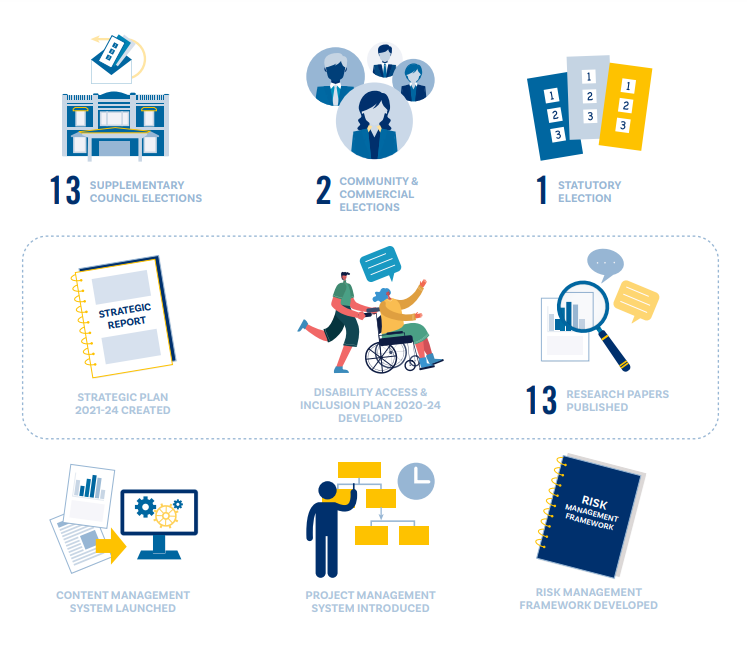
Following is a snapshot of data and statistics from the 2020-21 financial year.
Download a copy of the Annual Report 2020-21.
Our highlights
Our people
| Number of staff | 32 | |
| FTEs | 30.83 | |
| Gender | Persons | FTE |
| Female | 50% | 48.1% |
| Male | 50% | 51.9% |
| No. persons separated from the agency during 2019-20 | 3 | |
| No. persons recruited to the agency during 2019-20 | 9 | |
| No. persons on leave without pay at 30/6/20 | 1 | |
Elections
Summary of council elections
| Council | Date | Ratio of candidates to vacancy | No of electors on roll | Election contested | Participation (no) | Participation (%) |
| District Council of Mount Remarkable Telowie Ward | 13/07/20 | 2:1 | 964 | Y | 426 | 44.19% |
|
City of Mitcham Gault Ward |
10/08/20 | 74:1 | 7,655 | Y | 1,814 | 23.7% |
|
Yorke Peninsula Council Gum Flat Ward |
7/09/20 | 7:1 | 2,522 | Y | 1,204 | 47.74% |
|
City of Unley Parkside Ward |
7/09/20 | 6:1 | 4,298 | Y | 963 | 22.41% |
|
City of Onkaparinga Mid Coast Ward |
7/09/20 | 18:1 | 23,646 | Y | 3,917 | 16.57% |
|
City of Mitcham Gault Ward |
12/10/20 | 3:1 | 7,668 | Y | 1,961 | 25.57% |
|
District Council of Grant Central Ward |
12/10/20 | 1:1 | N/A | N | N/A | N/A |
| Clare & Gilbert Valleys Council Area Councillor | 1/03/21 | 4:1 | 6,714 | Y | 2,513 | 37.43% |
|
Flinders Ranges Council Mayor |
1/03/21 | 1:1 | N/A | N | N/A | N/A |
|
Kangaroo Island Council Area Councillor (x2) |
1/03/21 | 3::2 | 3,446 | Y | 1,098 | 31.86% |
|
Copper Coast Council Area Councillor (x2) |
15/06/21 | 5:2 | 11,660 | Y | 3,640 | 31.22% |
|
Wudinna Area Councillor |
15/06/21 | 1:1 | N/A | Y | N/A | N/A |
|
Streaky Bay Eyre Ward |
12/07/21 | 1:1 | N/A | N | N/A | N/A |
Other statutory elections
| Organisation | Date | Election type | Election contested? | No. elected | Electoral system used | No. of electors |
| South Eastern Water Conservation and Drainage Board – Southern Zone | 27/07/20 | To elect 1 Landholder to the Board | Y | 1 | Single-member plurality voting | 1,907 |
The elections for the South Eastern Water Conservation and Drainage Board are held every four years. In total, three elections are managed for the following electoral zones; Central Electoral Zone, Northern Electoral Zone and Southern Electoral Zone. Two nominations were received for the Southern Electoral Zone. Ballot packs were sent out to those eligible electors with the election being finalised in July 20.
Community and commercial elections
| Organisation | Date | Election type | No. elected | Voting method | No. of electors |
| Adelaide Festival Centre – Professional and administration EA | 27/11/20 | Enterprise Agreement ballot | N/A | Yes – No First Past the Post | 95 |
| Adelaide Festival Centre – Performing Arts Centre EA | 12/02/21 | Enterprise Agreement ballot | N/A | Yes – No First Past the Post | 223 |
Enrolment
South Australia enrolment rate at 30 June 2021
| Enrolment | 30 June 2021 | 30 June 2010 | 30 June 2019 | 30 June 2018 | 30 June 2017 |
| Enrolment for federal/state and state only electors | 1,239,103 | 1,224,894 | 1,216,151 | 1,201,245 | 1,187,714 |
| Voting Eligible Population* | 1,283,395 | 1,263,503 | 1,248,996 | 1,241,490 | 1,241,031 |
| Total enrolled as % of Voting Eligible Population* | 96.5% | 96.9% | 97.4% | 96.8% | 95.7% |
Electors enrolled by age group at 30 June 2021
| Age group | No. | % of Voting Eligible Population* |
| 18-24 | 105,698 | 78.5% |
| 25-29 | 93,899 | 97.1% |
| 30-34 | 95,424 | 96.5% |
| 35-39 | 100,011 | 98.3% |
| 40-44 | 94,427 | #99.0% |
| 45-49 | 99,788 | 98.4% |
| 50-54 | 104,735 | 98.1% |
| 55-59 | 105,536 | 98.0% |
| 60-64 | 105,191 | 98.5% |
| 65-69 | 95,506 | #99.0% |
| 70+ | 238,888 | 96.5% |
| Total enrolled | 1,239,103 | 96.5% |
* Voting Eligible Population percentages are calculated by the Australian Electoral Commission (AEC) based on Estimated Eligible Population using ABS citizen population figures for 30 June 2019 (revised) and 30 June 2020 (preliminary) based on the 2016 Census. ABS data is adjusted by the AEC and projected forward to the relevant date, then adjusted for British Subjects, those of unsound mind, overseas electors and new citizens since the Census.
# Enrolment rates above 99.0% are not reported due to error associated with calculating Estimated Eligible Population which may overstate the actual enrolment rate.
Enrolment transactions 2017 to 2021
| Enrolment activity | 2020-21 | 2019-20 | 2018-19 | 2017-16 |
| As at 1 July of each year | 1,224,894 | 1,216,151 | 1,201,245 | 1,187,714 |
| Additions to the roll | 2020-21 | 2019-20 | 2018-19 | 2017-18 |
| New enrolments* | 22,480 | 23,496 | 27,477 | 27,610 |
| Re-enrolments | 2,893 | 4,351 | 5,109 | 5,238 |
| Re-instatements | 19 | 25 | 143 | 67 |
| Interstate transfers to SA | 12,974 | 11,112 | 15,267 | 14,235 |
| Net additions | 38,366 | 38,984 | 47,996 | 47,150 |
| Movements within state** | 2020-21 | 2019-20 | 2018-19 | 2017-18 |
| Transfers between districts | 69,787 | 74,255 | 80,728 | 86,541 |
| Changes within district | 32,089 | 34,209 | 42,648 | 49,974 |
| No change/amendments | 5,854 | 7,491 | 20,235 | 40,535 |
| Deletions from the roll | 2020-21 | 2019-20 | 2018-19 | 2017-18 |
| Removal by objection | 1,816 | 6,665 | 5,737 | 3,602 |
| Deaths | 10,877 | 10,932 | 10,793 | 11,735 |
| Duplications | 170 | 701 | 309 | 496 |
| Cancellations | 172 | 169 | 170 | 16 |
| Interstate transfers from SA | 11,119 | 11,776 | 16,084 | 17,777 |
| Net deletions | 24,154 | 30,243 | 3,093 | 33,626 |
| Adjustments (net)*** | -3 | +2 | +3 | +7 |
| Total enrolled 30/06/21 | 1,239,103 | 1,224,894 | 1,216,151 | 1,201,245 |
* Includes persons who have provisionally enrolled that have turned 18 and new enrolments by 18 year olds (10,232 in 2020-21).
** These ‘movements within state’ figures are not included in the table totals below.
*** Net adjustments and data corrections.
Registered declaration voters by criteria at 30 June 2021
ECSA maintains a register of voters who are permanently prevented from attending a polling booth and meet certain criteria. These voters are called registered declaration voters for state elections and general postal voters for federal elections. Once registered, a voter will always receive a postal vote for every election and does not need to re-apply for future elections.
| Criteria | No. | % |
| Caring for a person who is seriously ill, infirm or disabled | 1,342 | 5.8% |
| Place of residence is not within 20 kilometres of a polling place | 3,324 | 14.4% |
| Physical disability | 6,529 | 28.3% |
| Membership of a religious order or religious beliefs | 450 | 1.9% |
| Address has been suppressed from publication on the roll (silent elector) | 11,151 | 49.6% |
| Total | 23,096 | 100% |
Register of political parties
Eight political parties were registered for state elections in South Australia.
| New party registrations | 0 |
| Annual returns lodged | 8 |
| De-registrations* | 0 |
| Currently registered parties (as at 30 June 2021) | 8 |
Registered political parties at 30 June 2021
| Date of registration | Name of registered political party | Abbreviation of party name |
| 17/10/85 | Australian Labor Party (South Australian Branch) | Australian Labor Party |
| 17/10/85 | Liberal Party of Australia (SA Division) | Liberal Party |
| 17/10/85 | National Party of Australia (SA) Inc | The Nationals |
| 13/2/96 | Australian Greens SA | The Greens |
| 24/11/16 | Animal Justice Party | |
| 4/7/17 | SA-BEST Incorporated | SA-BEST |
| 7/11/17 | Advance SA | |
| 12/12/17 | Child Protection Party | CPP |
Funding, disclosure and returns
Returns
Political Party Returns, Associated Entity Returns and Donor Returns are lodged on a half-yearly basis and must be lodged within 30 days of the end of the half-yearly period.
In July 2020, ECSA received returns for the period 1 January 2020 to 30 June 2020. The table below summarises the return lodgements for the period.
Returns for period 1 January 2020 to 30 June 2020.
| Return type | Total lodged | Late returns |
| Political Party Return | 10* | 2 |
| Associated Entity Return | 24 | 10 |
| Donor Return | 9 | 5 |
| Large Gift Return | 2 | 2 |
* Danig Party of Australia (SA Division) and Liberal Democratic party lodged a return, however were deregistered on 28 November 2019.
In January 2021, ECSA received returns for the period 1 July 2020 to 31 December 2020. The table below summarises the return lodgements for the period.
Returns for period 1 July 2020 to 31 December 2020.
<| Return type | Total lodged | Late returns |
| Political Party Return | 8 | 1 |
| Associated Entity Return | 24 | 0 |
| Donor Return | 3 | 0 |
Annual Political Expenditure Returns lodged for the 2019-20 financial year
| Return type | Total lodged | Late returns |
| Political Party Annual Political Expenditure | 2 | 0 |
| Individual Annual Political Expenditure | 0 | 0 |
| Organisation Annual Political Expenditure | 0 | 0 |
| Associated Entity Annual Political Expenditure | 0 | 0 |
| Third Party Annual Political Expenditure | 0 | 0 |
All returns lodged are available on ECSA’s Funding and Disclosure Portal.
Public funding
| Claim Period | Australian Labor Party | Liberal Party | The Greens | SA-Best | Advance SA | Total | |
| 1/1/21 – 30/06/21 | $66,109 | $66,109 | $38,564 | $38,564 | - | $209,346 | |
| 1/7/20 – 31/12/20 | $66,109 | $66,109 | $38,564 | $29,071.53 | - | $199,853.53 | |
| Total | $132,218 | $132,218 | $77,128 | $67,635.53 | - | $409.199.53 |
No general election or by-election was held in the 2020-21 financial year and ECSA was not called upon to pay election funding to reimburse political expenditure incurred by eligible participants in relation to an election.
Non-voter activity
Non-voter activity
Section 85 of the Electoral Act 1985 sets out the procedures to be implemented by the Electoral Commissioner relating to electors who appear to have not voted at an election. The non-voter process commences three months after election day and continues until each expiation has been resolved.
The table below outlines the non-voter activity, starting with Notice 1 which gives the elector the opportunity to provide a valid reason for their apparent failure to vote, through to referral of the expiation to the Fines Enforcement and Recovery Unit (FERU).
Once an expiation has been referred to FERU an elector can make an application for a review. If the review is granted the expiation is referred back to ECSA and the expiation is reissued (Notice 2). There is no maximum numbers of review that can be granted. This cycle can occur multiple times if the matter is left unresolved.
| Activity | 2020-21 | 2019-20 | 2018-19 | 2017-18 |
| Notice 1: Notice of Apparent Failure to Vote (No. sent) | n/a | n/a | * n/a # 8,747 |
* 63,715 |
| Notice 2: Expiation Notice (No. sent) | n/a | n/a | * 37,480 # 5,966 |
n/a |
| Notice 3: Reminder Expiation Notice (No. sent) | n/a | * n/a # 4,046 |
* 27,942 # n/a |
n/a |
| Referrals to the Fines Enforcement and Recovery Unit for enforcement | n/a | * 257 # 3,278 |
* 23,115 # n/a |
n/a |
| Re-issued expiation notices (No. sent) | *26 #18 |
* 1,605 # 413 |
* 3,873 # n/a |
n/a |
| Penalties collected ($) | $125,617.27 | $389,543.65 | $769,097.43 | $20,447.40 |
* 2018 State Election
# 2019 Cheltenham and Enfield by-elections