
Parties and Candidates
- Details
On this page
- Overview
- Electoral reforms
- Public funding
- Appointing an agent
- Prescribed details
- State campaign accounts
- Expenditure caps
- Reporting and disclosure obligations
- Types of funding
- By-elections
Overview
The Electoral Commission of South Australia (ECSA) provides funding to support election-related activities under the Electoral Act 1985 (the Act). This includes funding for registered political parties, independent MPs, candidates, and groups. All payments are indexed annually in line with the Consumer Price Index (CPI).
Key funding streams
Registered political parties may be eligible for:
- Public funding - including advance payments to support campaign activities
- Administrative expenditure funding - covering operational costs, with options for one-off payments
- Policy development funding - to assist in the formulation of party policies.
Electoral reforms
From 1 July 2025, the Electoral (Accountability and Integrity) Amendment Act 2024 introduced reforms to South Australia’s electoral framework to strengthen transparency, accountability, and integrity in electoral funding and political donations.
To support stakeholders, ECSA will provide ongoing guidance to assist participants in understanding their obligations under the new legislation; however, independent legal advice is encouraged.
Public funding
Public funding supports registered political parties in covering costs associated with state election campaigns and by-elections.
Eligibility
To qualify for public funding:
- A political party must be registered for at least 8 months prior to the election.
- Funding is only available for endorsed candidates or groups who receive eligible votes (i.e. first preference votes on formal ballot papers).
- The amount payable is determined by section 130P of the Act.
Funding entitlement
Public funding is calculated per eligible vote and varies depending on the party’s parliamentary representation at the time of the election. There are 2 types of entitlements: standard, for parties with at least one sitting member of parliament, and tapered, for parties without parliamentary representation.
| Party status | Entitlement type | Funding rate (2026 indexed) |
|
Party with at least one MP at dissolution |
Standard |
$5.50 per eligible vote |
| Party with no MPs at dissolution |
Tapered |
$6.00 per vote for first 10% of total primary votes $5.50 per vote thereafter |
Important:
- Funding is limited to actual political expenditure incurred.
- No payment will be made without satisfactory evidence of campaign-related costs.
- Payments are indexed annually in line with the Consumer Price Index (CPI).
Appointing an agent
Agents manage funding and disclosure obligations and ensure compliance with the Act.
👉 See our agents page for details.
Prescribed details for returns
Under the Act, all participants required to lodge returns, including registered political parties, third parties, associated entities, and their agents, must include prescribed details to meet funding and disclosure obligations.
👉 See our prescribed details page for more information.
State campaign accounts
Required for managing donations, public funding, and political expenditure. Must be opened with an authorised bank and registered with ECSA.
👉 See our state campaign accounts page for details.
Expenditure caps
Expenditure caps apply to political participants during election periods. These rules help ensure fairness and transparency in campaign spending.
- Spending limits apply from 1 July before the election to 30 days after polling day.
- Participants spending over $5,000 must lodge a capped expenditure return within 60 days after polling day.
👉 See our expenditure caps page for details.
Reporting and disclosure obligations
For registered political parties, section 130ZN of the Act outlines the reporting requirements. The agent of each registered political party is required to submit a political party return at prescribed times, in a format approved by the Electoral Commissioner.
👉 See our reporting and disclosure obligations for political parties page for details.
Types of funding
Advance funding
Registered political parties may apply for advance funding before polling day by lodging a section 130PF certificate. Once lodged, the certificate cannot be withdrawn.
Advance funding is paid in instalments and calculated based on either:
- Previous election results (notional amount), or
- A legislated set amount (e.g. $2,500 per candidate – 2026 indexed)
Eligibility, payment structure, and repayment rules vary depending on:
- Whether the party is recontesting
- Whether endorsed candidates are current or former MPs
- Whether the election is for the House of Assembly or the Legislative Council.
👉 For full details, see:
By-elections
Advance public funding is available in a House of Assembly by-election, but only under strict conditions.
👉 Learn more on our advance funding page.
Administrative funding
Administrative funding (formerly known as special assistance funding) is a form of public funding provided under Division 5 of the Electoral Act 1985 (the Act). It is paid as a half-yearly entitlement to eligible registered political parties and independent members of parliament to assist with the reimbursement of administrative expenditure.
Funding is available to:
- Registered political parties with one or more members in the South Australian Parliament (House of Assembly or Legislative Council)
- Independent members of parliament.
👉See or administrative funding page for details.
Policy development funding
Policy development funding supports eligible registered political parties by reimbursing costs related to developing party policies. This funding is separate from campaign-related funding and is subject to specific eligibility and expenditure rules.
- Details
On this page
- Agent definition
- Eligibility
- Agent roles
- Appointing an agent
- Agent obligations
- Prescribed details for returns
- Record keeping
- Register of agents
Definition
An agent is a person appointed by a registered political party, candidate, group of candidates or third party to manage their funding and disclosure obligations under Part 13A of the Electoral Act 1985 (the Act). Agents can be formally appointed or deemed to be agents under the legislation.
Agents are responsible for ensuring the person or organisation they represent meets all legal requirements for funding and disclosure.
👉 View the current register of agents.
Eligibility criteria
- The person must be a natural person aged 18 years or over.
- A person cannot act as an agent if they have been convicted of a prescribed offence (section 130G(3)).
Agent roles by recipient type
The Act sets out who the agent is for each type of recipient.
| Recipient | Agent |
| Registered political party | Must appoint a person to be the agent of the party. By default, the party agent is also the agent for any endorsed candidates or members of a group of candidates. |
| Candidate in an election | May appoint a person to be their agent. If no appointment is made, the candidate is taken to be their own agent. |
| Members of a group of candidates | May appoint a person to be the agent of the group. If no appointment is made, the candidate whose name appears first in the group on the ballot paper is taken to be the agent. |
| Third party | May appoint a person to be their agent. If no appointment is made: (a) where the third party is a natural person, the third party is taken to be the agent; (b) in any other case, each member of the executive committee is taken to be the agent. |
| Associated entity | May appoint a person to be their agent. If no appointment is made, the financial controller of the associated entity is taken to be the agent. |
Appointing an agent
The appointment must be made in writing and include:
- The name and address of the proposed agent.
- A signed consent and declaration confirming eligibility.
Candidates, groups, and third parties cannot change their agent after the close of nominations. Registered political parties are the only recipients permitted to change their agent after the close of nominations (section 130G(4)).
Acting agent appointment
If an agent is temporarily unavailable, they can appoint a qualified acting agent in writing to carry out their duties. The appointment must include the acting agent’s name and address and be sent to the Electoral Commissioner.
- The appointment can last up to 3 months and starts only when the Commissioner receives a copy.
- The appointment ends early if the original agent’s role ends or the acting agent is convicted of a relevant offence.
- While an acting agent is appointed, the original agent cannot perform their functions.
- The appointment can be revoked in writing, with a copy sent to the Commissioner.
Changing or ending an agent appointment
Revoking an agent
Candidates, groups of candidates, third parties, and associated entities can revoke their agent by giving written notice to the Electoral Commissioner. The notice must be signed by the candidate, each member of the group, or the third party, as relevant.
A registered political party may only revoke an agent's appointment if they also give a notice of appointment of another agent.
Death or resignation
If the agent dies or resigns, the relevant person must, within 7 days, give the Electoral Commissioner notice in writing. Registered political parties must provide notice and appoint another agent within 28 days of the agent’s death.
Conviction of an offence
If an agent is convicted of an offence under Part 13A of the Act or Part 20 of the Commonwealth Electoral Act 1918, their appointment automatically ends (subject to any appeal). The appointing person or body must notify the Electoral Commissioner of a replacement agent within 28 days of the conviction, or if there is an appeal, within 28 days of the appeal being determined. Registered political parties must also notify the Electoral Commissioner of the replacement agent within the same timeframes.
Obligations of an agent
General obligations
- Set up a state campaign account (section 130K).
- Manage funds correctly: ensure all donations are paid into the campaign account and all political spending comes out of it (sections 130L and 130M).
- Keep accurate records: record donations of $200 or more and loans of $500 or more.
- Lodge returns for their client at the required times.
- Provide audit certificates for returns, or apply for a waiver from the Electoral Commissioner (section 130ZV).
- Comply with notices to produce information or give evidence (section 130ZZB).
- Inform donors or loan providers about reporting obligations (sections 130ZG(7) and 130ZH(8)).
- Monitor expenditure: ensure the client does not exceed the allowed expenditure cap if participating in the public funding scheme.
Additional obligations for registered political party agents
- Keep administrative funding separate (section 130W).
- Notify the Electoral Commissioner if the party shares its capped political expenditure with candidates (section 130Z(3)).
- Negotiate shared public funding with another registered party (section 130R(4)).
- Lodge a claim for administrative funding (section 130U).
Penalties for non-compliance
- Prosecution: Agents can be prosecuted for failing to meet their legal responsibilities.
- Fines: Offences against Part 13A attract fines ranging from $1,500 to $50,000.
- Loss of eligibility: A person convicted of an offence under Part 13A is not eligible to act as an agent.
Prescribed details for returns
Under the Act, agents appointed by registered political parties, third parties, and associated entities are legally responsible for submitting accurate and complete returns to ECSA. These returns must include prescribed details to meet funding and disclosure obligations. These include:
- Agent information: Name, contact details, and appointment status.
- State campaign account details: Bank name, account number, and registration confirmation.
- Receipts and debts: All amounts received or owed over $1,000, including the name and address of the donor or creditor.
- Donations: Source, amount, purpose, and confirmation that the donor is not a foreign entity.
- Political expenditure: Evidence of campaign-related spending.
- Annual and election returns: Lodged within statutory timeframes.
If the donor or creditor is an association, trust, foundation, or body corporate, the return must also include:
- Names of executive committee or board members.
- Parent, subsidiary, or related entities.
- These details can be omitted if they are publicly available and the return includes a reference and website link to the publication.
Record retention requirements
Agents must keep any document that contains information included (or required to be included) in a return for at least 4 years from the date of the relevant election (section 130ZZA).
Donation and loan recordkeeping
- Donations: Record the name and address of donors for any donations of $200 or more (section 130ZJ).
- Loans: Record the terms and lender details for loans of $500 or more, unless from a financial institution.
Financial institutions include ADIs (banks, credit unions, building societies) or other bodies prescribed by regulation.
What counts as a loan
Includes advances, credit, financial accommodation, or any transaction that effectively results in a loan, including credit card transactions.
Additional entity details
If a donation or loan comes from a trust, foundation, board, or association, record the names of all trustees or governing members.
Disclosure threshold
- Donations or loans over $1,000 (indexed) must be disclosed in a return.
- You must still maintain the required records, even if disclosure is not required.
Responding to evidence requests
The Electoral Commissioner may require a person to produce documents or appear to give evidence; non-compliance or the provision of false information attracts a penalty of up to $10,000 (section 130ZZB).
Register of agents
| Party name | Agent |
| Animal Justice Party | Lionel Pengilley |
| Australian Citizens Party (SA) Division | Craig Isherwood |
| Australian Family Party | Robert Day |
| Australian Greens SA | Diane Atkinson |
| Australian Labor Party (SA Branch) | Aemon Bourke |
| Family First Party Inc | John Snelling |
| For Unley | Ryan Harrison |
| Jing Lee - Better Community | Eddie Liew |
| Legalise Cannabis SA Party | Jason Meotti |
| Liberal Party of Australia (SA Division) | Alexander Hyde |
| Libertarian Party SA | Jessica Colby |
| National Party of Australia (SA) Inc | Grantley Mason Siviour |
| Pauline Hanson’s One Nation | Carlos Quaremba |
| SA Socialists | Phoebe Kelloway |
| SA-BEST Inc | Rocco Romeo |
| Sarah Game Fair Go for Australians | John Lutman |
| STEPHEN PALLARAS REAL CHANGE SA | Daniel Pallaras |
| United Voice Australia Party | Helen Hoare |
- Details
On this page
- Overview
- Electoral reforms
- Public funding
- Appointing an agent
- Prescribed details
- State campaign accounts
- Expenditure caps
- Reporting and disclosure obligations
- Types of funding
- By-elections
Overview
The Electoral Commission of South Australia (ECSA) provides funding to support election-related activities under the Electoral Act 1985 (the Act). This includes funding for registered political parties, independent MPs, candidates, and groups. All payments are indexed annually in line with the Consumer Price Index (CPI).
Key funding streams
- Public funding - including advance payments to support campaign activities
- Administrative expenditure funding - covering operational costs, with options for one-off payments
- Policy development funding - to assist in the formulation of party policies.
👉 See funding and disclosure information specific to political parties.
Electoral reforms
From 1 July 2025, the Electoral (Accountability and Integrity) Amendment Act 2024 introduced reforms to South Australia’s electoral framework to strengthen transparency, accountability, and integrity in electoral funding and political donations.
To support stakeholders, ECSA will provide ongoing guidance to assist participants in understanding their obligations under the new legislation; however, independent legal advice is encouraged.
Public funding
Public funding supports registered political parties, candidates, and groups in covering costs associated with state election campaigns and by-elections. The amount of funding is calculated per eligible vote and varies depending on the participant’s type and parliamentary status.
Eligibility
To qualify for a payment of public funding, candidates, groups, and registered political parties must meet specific eligibility criteria:
- Candidates: Must be elected or receive at least 4% (House of Assembly) or 2% (Legislative Council) of total primary votes.
- Groups: Must have at least one elected member or receive at least 2% of total primary votes (Legislative Council).
- Registered political parties:
- Must have been registered for at least 8 months prior to the election.
- Must meet vote thresholds similar to candidates and groups.
- Must provide satisfactory evidence of political expenditure to receive funding.
- Must operate a state campaign account for managing public funding and electoral expenses.
Funding entitlement
Public funding is calculated per eligible vote and varies depending on the type of participant and their parliamentary status. There are 2 types of entitlements: standard and tapered.
| Candidate or group type | Entitlement type | Funding rate (2026 indexed) |
|
Endorsed by a registered political party with at least one MP at dissolution |
Standard |
$5.50 per eligible vote |
| Endorsed by a registered political party with no MPs at dissolution |
Tapered |
$6.00 per vote for first 10% of total primary votes $5.50 per vote thereafter |
| Independent candidate or group with a sitting MP at dissolution | Standard | $8.50 per eligible vote |
| Other independent candidates or groups | Tapered | $9.00 per vote for first 10% of total primary votes $8.50 per vote thereafter |
Important:
- Funding is limited to actual political expenditure incurred.
- No payment will be made without satisfactory evidence of political expenditure.
Appointing an agent
Agents manage funding and disclosure obligations and ensure compliance with the Act.
👉 See our agents page for details.
Prescribed details for returns
Under the Act, all participants required to lodge returns, including registered political parties, third parties, associated entities, and their agents, must include prescribed details to meet funding and disclosure obligations.
State campaign accounts
Required for managing donations, public funding, and political expenditure. Must be opened with an authorised bank and registered with ECSA.
Expenditure caps
Expenditure caps apply to political participants during election periods. These rules help ensure fairness and transparency in campaign spending.
- Spending limits apply from 1 July before the election to 30 days after polling day.
- Participants spending over $5,000 must lodge a capped expenditure return within 60 days after polling day.
👉 See our expenditure caps page for details.
Reporting and disclosure obligations
Political participants must meet specific reporting requirements under South Australian electoral law. These obligations ensure transparency in campaign financing and political expenditure.
Relevant links:
Types of funding
Advance funding
Provides early access to public funds before polling day. Requires eligibility certification and may require repayment if conditions aren’t met.
👉 Learn more on our advance funding page.
👉 For detailed information, see:
By-elections
Advance public funding is available in a House of Assembly by-election, but only under strict conditions.
👉 Learn more on our advance funding page.
Administrative funding
Administrative funding (formerly known as special assistance funding) is a form of public funding provided under Division 5 of the Act. It is paid as a half-yearly entitlement to eligible registered political parties and independent members of parliament to assist with the reimbursement of administrative expenditure.
Funding is available to:
- Registered political parties with one or more members in the South Australian Parliament (House of Assembly or Legislative Council)
- Independent members of parliament.
Policy development funding
Reimburses registered parties for policy-related expenses incurred during the financial year.
- Details
On this page:
- Definitions
- Authorisation requirements
- Restrictions on display of electoral advertisements
- Headings on electoral advertisements
- Misleading advertising
- How-to-vote cards
- Broadcast media authorisations
- Digital advertising
- Artificial intelligence (AI)
This page provides guidance on the legal requirements for electoral advertising during South Australian state elections. All candidates, parties, and third-party campaigners must comply with the Electoral Act 1985 (Electoral Act) and associated Electoral Regulations 2024 (Electoral Regulations).
References
- Broadcasting Services Act 1992 (Cth)
- Electoral Act 1985 (SA)
- Electoral (Control of Corflutes) Amendment Act 2024
- Electoral (Miscellaneous) Amendment Act 2024
- Electoral Regulations 2024
- Local Government Act 1999
- Guidelines for the broadcast of political matter (Australian Communications and Media Authority (ACMA))
Definitions
Electoral Act - Part 1, section 4.
- Electoral advertisement: An advertisement containing electoral matter.
- Electoral matter: Matter calculated to affect the result of an election.
Note: The Electoral Commission of South Australia (ECSA) cannot provide legal advice. If you're unsure about your obligations, we strongly recommend seeking independent legal advice.
Authorisation requirements
Under section 112 of the Electoral Act, any electoral advertisement, whether printed or published online, must include:
- Name and street address of the authoriser (a PO Box cannot be used).
Note: Independent candidates (those not endorsed by a registered political party) may use a PO Box instead of a street address if they have approval from the Electoral Commissioner and the suburb where the candidate lives is included at the end of the advertisement. - If authorised for a registered political party or an endorsed candidate: the party's name or its registered abbreviation.
- If authorised for a relevant third party: the name of that third party.
Exceptions: Small items such as stickers, badges, lapel buttons, pens, pencils and balloons are exempt.
Compliance note: Failure to include correct authorisation details is an offence.
Maximum penalty: $5,000 for individuals, $10,000 for bodies corporate.
Restrictions on the display of electoral advertisements
Section 115 of the Electoral Act and the Electoral (Control of Corflutes) Amendment Act 2024.
Size of electoral advertisements
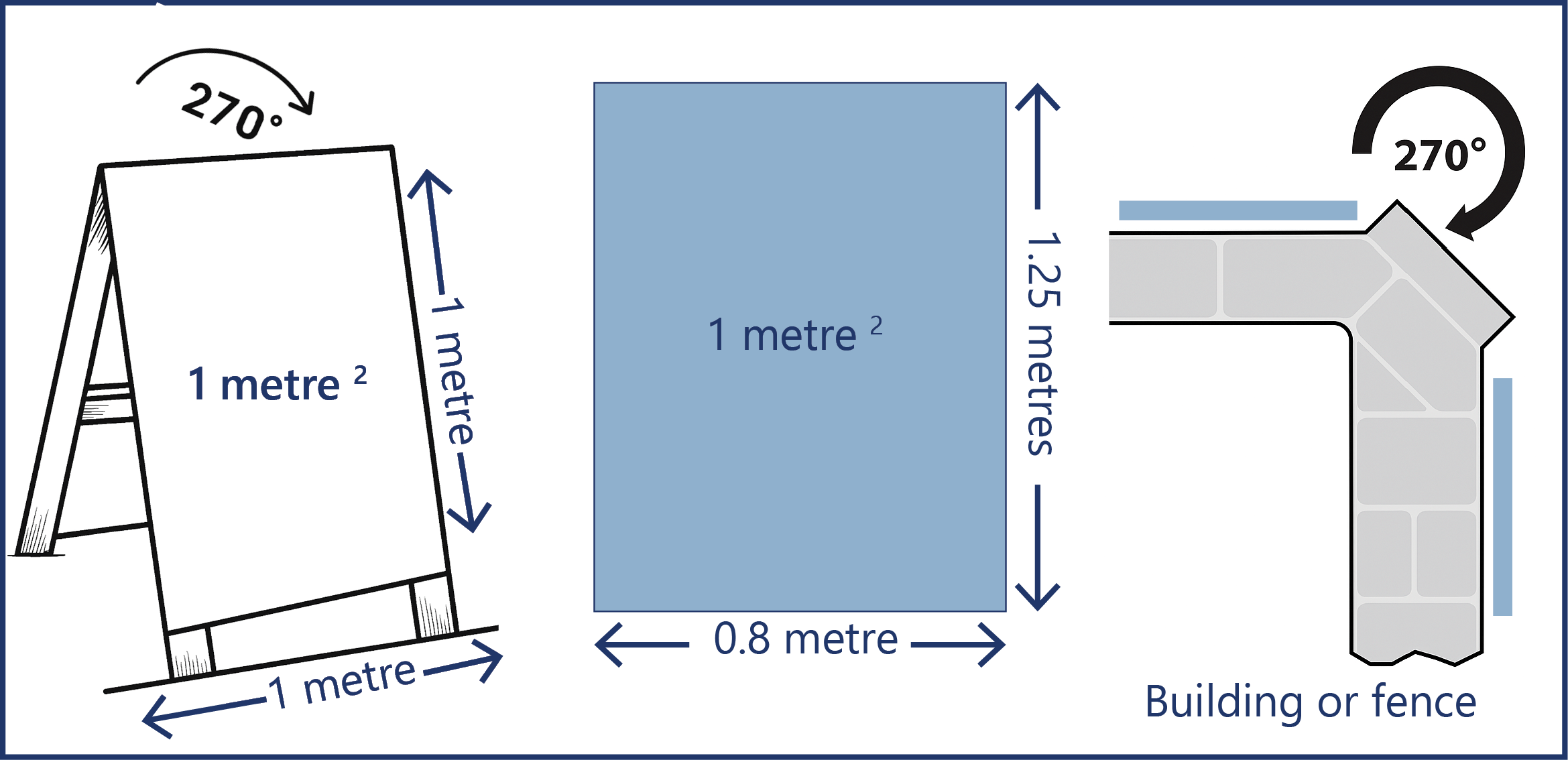
- Advertisements on vehicles, buildings, hoardings, or structures must not exceed 1 square metre.
- Advertisements within 1 metre of each other for the same candidate or party are treated as a single advertisement.
Penalty: Up to $5,000.
Prohibited locations
- It is prohibited to exhibit electoral advertising posters on public roads or road-related areas, including structures, fixtures, or vegetation.
Penalty: Up to $5,000.
Exceptions
- Posters held by a person (directly or attached to a device).
- Posters not attached to a structure, displayed at or near a designated event or activity immediately before, during, or after (maximum 6 hours).
- Posters of a prescribed kind or in prescribed circumstances under regulations.
Compliance note: Significant penalties apply for breaches of size and placement rules under section 115.
Enquiries about the placement of signs in public spaces (e.g. height, location) should be directed to the relevant council, as these matters fall under the Local Government Act 1999.
Headings on electoral advertisements
Part 13, Division 2 of the Electoral Act.
All electoral advertisements must clearly identify the candidate or party they promote. Headings should not mislead voters about the source or purpose of the advertisement.
Misleading advertising
Under section 113 of the Electoral Act, it is an offence to publish electoral material that contains statements of fact that are inaccurate and misleading to a material extent.
Maximum penalty: $5,000 for individuals, $25,000 for bodies corporate.
The Electoral Commissioner may require withdrawal or publication of a retraction.
How-to-vote cards
Part 6 of the Electoral Regulations.
How-to-vote cards must comply with authorisation requirements and must not mislead voters. They should clearly indicate the candidate or party issuing the card and follow the official ballot format.
Broadcast media authorisations
Section 112 of the Electoral Act and the 'Guidelines for the broadcast of political matter' (Australian Communications and Media Authority (ACMA)).
- Radio advertisements must include a spoken authorisation at the end of the advertisement. This format requirement is governed by federal broadcasting regulations, including the Broadcasting Services Act 1992 and ACMA guidelines.
- Television advertisements must include both a spoken and a text-based authorisation at the end of the advertisement. Also governed by federal broadcasting regulations.
While section 112 of the Electoral Act outlines the content of the authorisation (i.e., what must be included), the formatting requirements for broadcast media are set by federal law and apply nationally, including in South Australia.
Digital advertising
Online and social media advertising must comply with authorisation requirements. Paid digital ads may be subject to additional disclosure obligations under the Electoral Act.
Artificial intelligence in electoral advertising
Under sections 115B to 115D of the Electoral Act, it is prohibited to publish or distribute electoral advertising generated by artificial intelligence that falsely depicts a person performing acts they did not do.
Penalty: Up to $10,000 for breaches.
Consent exception: Allowed only if the person depicted has given written consent and the advertisement is clearly labelled as AI-generated.
The Electoral Commissioner may order removal of such ads and require corrective statements.
- Details
On this page
- Overview
- Purpose
- Eligibility
- Use of funds
- Funding amounts
- Administrative funding payments
- One-off payments
- Repayments
Overview
Administrative funding (formerly known as special assistance funding) is a form of public funding provided under Division 5 of the Electoral Act 1985 (the Act). It is paid as a half-yearly entitlement to eligible registered political parties and independent members of parliament to assist with the reimbursement of administrative expenditure.
Before the amendments introduced by the Electoral (Accountability and Integrity) Amendment Act 2024, public funding provided under Division 5 of the Electoral Act was known as special assistance funding.
👉 View historical special assistance funding.
For detailed instructions and legislative references, see the Administrative Funding Guide (PDF, 241KB).
Purpose
Registered political parties and independent members of parliament may be eligible to receive administrative funding. This funding is to cover administrative expenses, including:
- Administration, operation or management of the activities of the party or member.
- Communication with members of the party on administrative, operational or management matters.
- Conferences, seminars, and meetings at which policies are discussed or formulated.
- Complying with the Act and auditing of financial accounts.
- Expenditure and remuneration of staff.
- Training of staff and volunteers.
- Equipment or vehicles whilst engaged in the matters referred to above.
- Office accommodation for staff and equipment.
- Expenditure on interest payments on loans.
Eligibility
Registered political parties
To be eligible for administrative funding, a registered political party must:
- Have at least one member in the South Australian Parliament (House of Assembly or Legislative Council) during the period.
- Be registered on the polling day of the most recent general election.
- Remain registered for the entire funding period.
Special rule for 2025
Despite section 130 U(1)(b)(ii) of the Act, a registered political party will still be considered eligible for the July—December 2025 half-year period if:
- it was registered on or before 1 August 2025, and
- It stayed registered until 31 December 2025.
Independent members of parliament
Independent members of parliament are also eligible for administrative funding.
Who is not eligible
- Parties with no members in either the House of Assembly or Legislative Council.
Use of funds
- Administrative funding must not be paid into a state campaign account.
- Administrative funding must not be used for political or electoral expenditure.
- Two or more registered political parties cannot rely on the same person for entitlement to, or payment of, administrative funding.
How to apply
- Complete the administrative expenditure funding application form within 30 days of the end of the period.
- Return the completed form by email to
This email address is being protected from spambots. You need JavaScript enabled to view it.
Funding amounts
Payments are made twice a year (half-yearly) and are indexed annually in line with the Consumer Price Index (CPI).
Payment structure
| strong>Recipient type | Elected members | Funding amount (half-yearly) |
| Registered political party | 1 member | $85,000 |
| Registered political party | 2 members | $245,000 |
| Registered political party | Each additional member (beyond 2) | $55,000 (capped) |
| Registered political party | Maximum funding | $800,000 |
| Independent member of parliament | 1 member | $20,000 |
View administrative funding payments by period
👉 Half-yearly payments made to eligible parties and independent members
One-off payment
Purpose
- Provides reimbursement for one-off costs including costs related to meeting funding and disclosure obligations.
- Recognises that reforms may create additional administrative burden for parties and independent members eligible for administrative funding.
Availability
- From 1 July 2025 to 3 August 2026.
How to claim
- Paid on receipt of a one-off administrative funding claim form.
Funding limit
- Registered political parties – up to a maximum of $200,000.
- Independent members of parliament – up to a maximum of $50,000.
If you have already claimed administrative funding, you cannot claim the same expense as part of this one-off payment.
Repayment of funds
The Electoral Commissioner may require repayment of unspent administrative funding in the following circumstances:
- Did not contest the election.
- Ceases to operate, becomes unregistered, or a seat becomes vacant.
- Changes status, such as:
- A non-party member joining a registered political party.
- Standing in an election for a registered political party.